

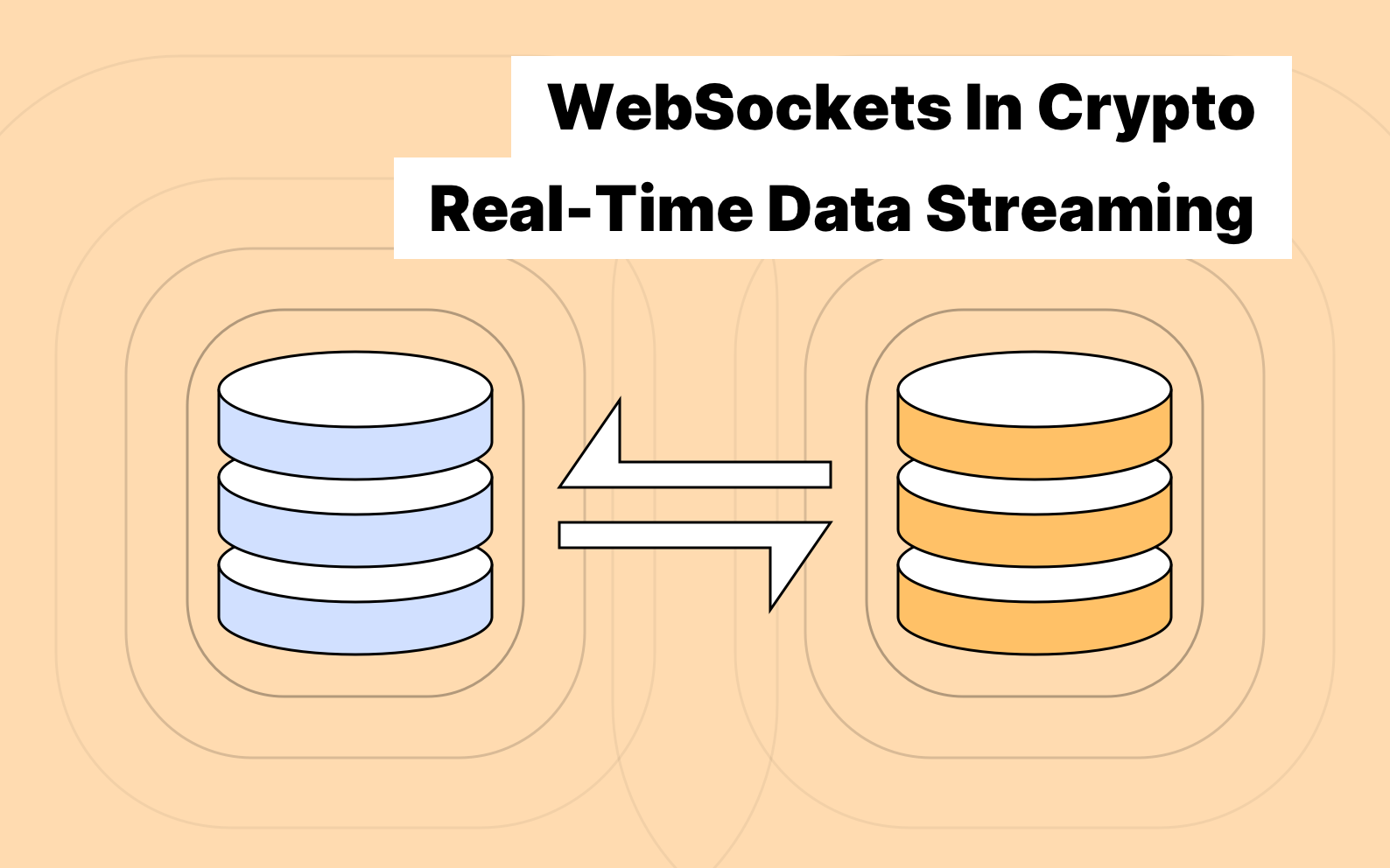
Prices, trades, and order books can change several times in the space of a second, making real-time communication essential for trading platforms, market-data tools, portfolio trackers, and automated strategies.
WebSockets make this possible by maintaining an open, two-way connection between a client and a server. Instead of repeatedly requesting fresh data, as a REST API would, the client receives price movements, completed trades, and order book updates as soon as the server publishes them.
So, in this guide, we will explain how WebSockets work in crypto, which WebSocket API providers are worth considering in 2026 and lots more.
What Are WebSockets APIs in Crypto?

A WebSocket keeps a connection open so a server can push new data to a client without waiting for another HTTP request. RFC 6455 defines the opening handshake and message framing used for two-way communication over TCP.
In crypto systems, “WebSocket API” can refer to several products that solve different problems:
- Exchange-native streams publish one venue’s trades, order book changes, tickers, candles, and authenticated account events.
- Market-data aggregators normalize prices or trades across multiple exchanges and, in some cases, decentralized markets.
- Blockchain node providers expose subscriptions for new blocks, pending transactions, logs, account changes, or contract events.
- Managed streams and webhooks add filtering, retries, backfill, or delivery to databases and cloud storage.
- Account aggregation APIs retrieve a user’s balances, positions, and transaction history across connected exchanges and wallets. They are complementary to low-latency market feeds, not replacements for them.
That distinction matters because a portfolio dashboard may need an aggregated price stream for valuation, a node stream for on-chain deposits, and an account aggregation API for the user’s complete holdings.
Choosing one provider before defining the data layer often leads to an expensive rebuild.
The Best Crypto WebSocket APIs in 2026
Now that we have covered how WebSockets work, let’s look at the leading crypto WebSocket APIs available in 2026.
1. CoinGecko: Best for Broad Aggregated Market Data
CoinGecko is the most practical starting point when an application needs normalized crypto prices across many centralized and decentralized markets.
Its current documentation lists more than 1,500 exchanges and 18,000 coins, plus on-chain DEX coverage across more than 200 networks, 1,800 DEXes, and 39 million tokens. CoinGecko’s API documentation describes REST, WebSocket, and webhook delivery methods.
One advantage that sets this API apart is its breadth. For example, a product can use one schema instead of maintaining separate market-data adapters for every venue. That suits portfolio valuation, market dashboards, alerts, discovery tools, and applications that need a representative price rather than one exchange’s exact order book.
The trade-off for such breadth is precision at the venue level because you’ll notice that aggregated prices are not the same as the executable bid, ask, depth, or queue position on a specific exchange.
So, a trading system that routes orders to Binance or Coinbase should consume that venue’s native market stream for execution decisions, even if it also uses CoinGecko for broader coverage.
2. CoinMarketCap: Best for Teams Already Using CMC Data
CoinMarketCap now documents a beta WebSocket API at wss://pro-stream.coinmarketcap.com/v1. It includes real-time market and on-chain channels. The official WebSocket reference lists cryptocurrency price streams as well as token, transaction, liquidity, holder, and pool metrics.
This is useful for teams that already rely on CoinMarketCap identifiers, REST endpoints, or on-chain datasets and want to reduce the number of vendors in their stack.
Do not treat it as a substitute for a raw exchange feed without testing the channel you need. CoinMarketCap’s documented latest-price channel updates roughly every five seconds for the top 500 cryptocurrencies and about every 15 seconds for other subscribed assets. That can be fast enough for dashboards and alerts, but not for strategies that need every trade or order book delta.
3. Binance: Best for Native Binance Market Depth
Binance WebSocket streams are a strong choice when the application trades on Binance or needs the exchange’s own trades, tickers, candles, book tickers, or order book updates. The feed avoids the ambiguity of an aggregated market price because every update belongs to the venue where the order may be executed. See the Binance Spot WebSocket documentation for endpoints and stream schemas.
Production systems must design around the documented controls. Binance limits a connection to five incoming control messages per second, allows up to 1,024 streams on one connection, and limits an IP address to 300 connection attempts per five minutes. Reconnect storms can therefore become an outage of their own if every worker retries at once.
Binance is not a market-wide solution. Add an aggregator when you need prices across many venues, or separate exchange adapters when execution can move between venues.
4. Coinbase: Best for Coinbase Market and User Streams
Coinbase Advanced Trade provides a public WebSocket endpoint for market data and a private endpoint for user data. The current Advanced Trade API documentation lists real-time market streams alongside user order, position, and futures-balance streams.
That makes Coinbase useful when one application needs both the market view and the authenticated account events that follow order placement. It also publishes machine-readable API specifications, which can reduce integration drift when schemas change.
The same limitation applies as with Binance: this is Coinbase data. It is not a normalized view of the entire crypto market. Keep venue identifiers, product types, sequence semantics, and authentication rules isolated inside a Coinbase adapter rather than leaking them through the rest of the application.
5. Alchemy: Best for EVM-oriented App Subscriptions
Alchemy is designed for applications that need blockchain events rather than exchange prices. Through WebSocket JSON-RPC subscriptions, an app can listen for new blocks, pending transactions, and contract logs on supported networks. Its WebSocket best-practices documentation is a useful implementation reference for Web3 applications.
Choose this category when the event is generated by a chain: a smart-contract log, token transfer, pending transaction, block, or confirmation. It is the wrong category for an exchange order book or a normalized market price.
A node provider supplies the connection and data. Your application still needs state recovery. After a disconnect, it must determine what it missed, query historical data when necessary, and process reorgs or duplicated events safely.
6. QuickNode: Best for WebSockets With a Managed-stream Path
QuickNode offers ordinary WSS endpoints for node subscriptions and a separate Streams product for teams that need historical backfill, filtering, reorganization handling, and delivery to webhooks, object storage, or databases. Its WebSocket versus Streams guide explains the architectural difference.
This gives a team two paths. A lightweight application can connect directly to a node and own the recovery logic. A data pipeline that cannot tolerate gaps can move to a managed delivery model instead of turning an application process into a home-built streaming platform.
The trade-off is commercial and architectural. Managed streams have their own pricing, delivery semantics, and operational model. Test the exact guarantees, destination behavior, replay window, and chain coverage required by your workload.
7. Helius: Best for Solana Subscriptions
Helius specializes in Solana. Its LaserStream WebSocket documentation covers standard Solana subscriptions such as accounts, programs, logs, signatures, and slots, plus Helius-specific transaction filtering.
The provider says LaserStream can be up to 200 milliseconds faster than standard Agave RPC-based WebSockets. Treat that as a provider claim until your own tests confirm it from the regions, networks, filters, and message paths your application will use.
Helius is compelling when Solana is the product’s center of gravity. A multichain platform may still need another provider or a normalization layer for EVM chains and centralized exchange data.
8. Bitquery: Best for Custom Multichain Filters
Bitquery exposes real-time blockchain data through GraphQL subscriptions at wss://streaming.bitquery.io/graphql. The official WebSocket subscription guide explains that billing is based on subscriptions, or streams, rather than the number of WebSocket connections.
GraphQL is the differentiator. Instead of accepting a fixed provider channel and filtering every message in your own infrastructure, you can describe the on-chain data shape and conditions you want. That fits analytics, compliance, DEX monitoring, wallet intelligence, and specialized transaction alerts.
The flexibility comes with a learning and cost-model trade-off. Prototype representative subscriptions before committing so you can measure points or stream usage, payload size, latency, and the operational effect of complex filters.
Other exchange-native WebSocket APIs
Kraken, Bybit, OKX, Crypto.com, and other major exchanges also publish WebSocket interfaces. An exchange-native API is usually the right choice when the product must reproduce that venue’s market state or react to private order and account events.
The selection criteria is about the venue your users trade on, the instruments you support, the depth of the order book, sequence and checksum rules, authentication, regional availability, and redistribution rights.
WebSocket vs. REST in Crypto
Traditional REST APIs use a request-response loop, while WebSockets keep one connection open and push updates as they happen. That single architectural difference produces large gaps in latency, bandwidth, and scalability.
A REST-based price tracker for Litecoin has to send a fresh HTTP request to each exchange every few seconds. By the time the response lands, the price may have already moved. Multiply that by ten exchanges, and the bandwidth cost climbs while the data still arrives stale.
The table below sums up the practical differences:
| Question | WebSocket | REST |
|---|---|---|
| Connection | Persistent; server pushes updates | Request and response |
| Best use | Trades, order book deltas, blocks, logs, account events | Snapshots, history, metadata, reconciliation, commands |
| Failure mode | Disconnects, stale sockets, gaps, duplicates, out-of-order events | Timeouts, rate limits, partial responses |
| Recovery | Reconnect, resubscribe, replay or backfill, then reconcile | Retry with idempotency and bounded backoff |
| State | Incremental updates often require a known starting state | Returns a point-in-time snapshot or requested range |
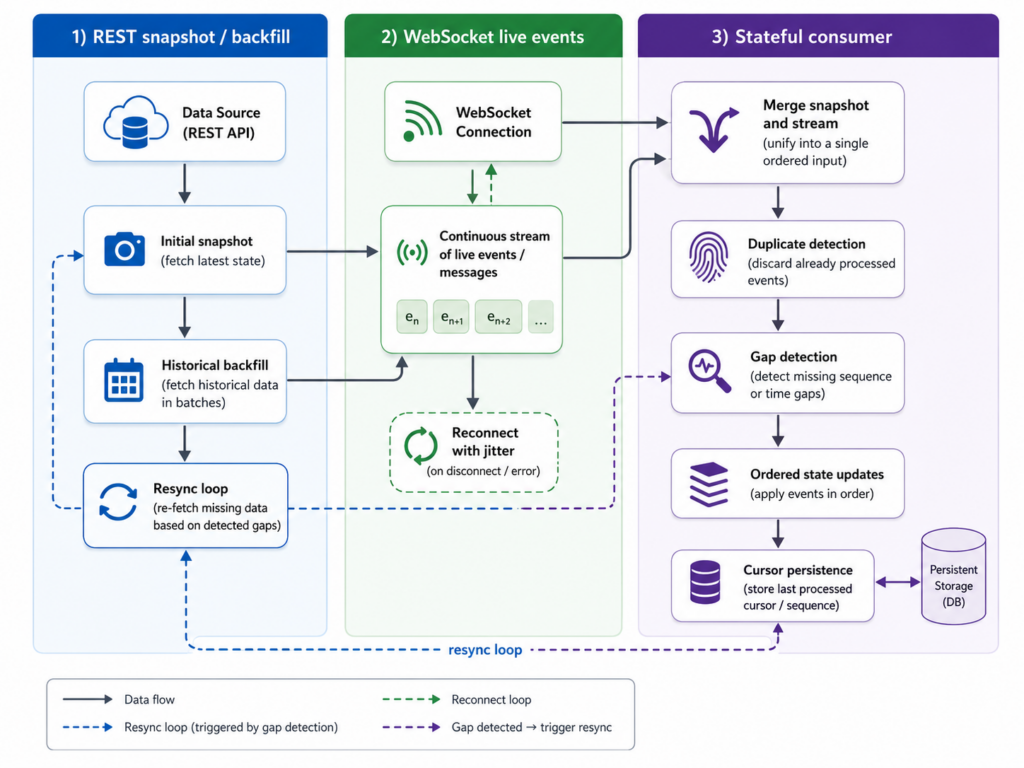
A common order book pattern is “snapshot plus stream.” Fetch the current book over REST, buffer WebSocket deltas while the snapshot loads, apply only updates that follow the snapshot sequence, and rebuild whenever a gap or checksum failure appears. This way, the WebSocket provides speed while REST restores truth.
The Production Pattern
Opening a socket is the easy part. A reliable integration must make a broken connection recoverable without silently corrupting application state.
- Define the canonical event: Normalize provider-specific symbols, timestamps, identifiers, units, and event types at the adapter boundary.
- Bootstrap state: Load a REST snapshot or historical cursor before treating live events as complete.
- Subscribe and buffer: Keep incoming events while the snapshot is loading so the application does not create a race-condition gap.
- Validate continuity: Use sequence numbers, slots, block heights, checksums, or provider cursors when available.
- Persist progress: Store the last safely processed cursor after the downstream write succeeds, not when the message first arrives.
- Reconnect with jitter: Use capped exponential backoff plus random jitter so many workers do not reconnect simultaneously.
- Backfill gaps: When continuity breaks, query the missing range or rebuild from a fresh snapshot before resuming.
- Process idempotently: A duplicate event should not create a duplicate trade, transfer, alert, or balance change.
- Monitor freshness: Track event age, last message time, reconnect count, gap count, processing lag, and failed downstream writes.
How to Evaluate a Crypto WebSocket API Provider
Marketing pages tend to compare asset counts and advertised latency. However, production failures usually come from less visible details. Test these before signing a long contract or building deeply into one schema:
- Data semantics: Does “price” mean last trade, midpoint, index, VWAP, or provider-calculated reference price?
- Granularity: Can you receive raw trades, top of book, full depth, candles, logs, decoded events, or only periodic summaries?
- Ordering and recovery: Are sequence numbers, checksums, cursors, historical replay, and reorg handling documented?
- Connection controls: How many connections, subscriptions, symbols, messages, and control frames are allowed?
- Authentication and security: Can keys be scoped, rotated, kept server-side, and restricted by IP, origin, or domain?
- Availability evidence: Does the provider publish a status page, incident history, SLA terms, and regional infrastructure?
- Licensing: May your product display, store, transform, redistribute, or resell the data?
- Pricing unit: Are you billed by connection, subscription, message, credit, bandwidth, asset, chain, or destination?
- Measured performance: Test end-to-end event age from several regions. Do not compare provider marketing numbers that use different clocks or payloads.
When WebSockets are the wrong tool
A persistent socket is not automatically the most reliable or economical delivery method. Prefer REST, webhooks, or a managed stream when:
- The application needs balances, metadata, tax history, or occasional portfolio refreshes rather than continuous ticks.
- Events must be delivered after a consumer outage without building your own replay layer.
- The destination is a warehouse, object store, or batch pipeline rather than an interactive application.
- The provider’s WebSocket payload is too broad and server-side filtering would materially reduce cost or bandwidth.
- The team cannot operate long-lived connections, backfill, idempotency, reorganization handling, and monitoring safely.
Where Vezgo fits in a real-time crypto stack
Vezgo solves a different data problem from an exchange ticker or blockchain-node WebSocket. The Vezgo API documentation describes integrations with more than 40 exchanges, 20 blockchains, and 250 wallets, returning normalized accounts, positions, balances, and historical transactions.
Use Vezgo when a product must understand what a user owns and what happened across connected accounts. Use a market-data or node WebSocket when the product must react to what is happening now. In a portfolio application, for example:
- CoinGecko or an exchange-native stream can update prices.
- Alchemy, QuickNode, Helius, or Bitquery can deliver on-chain events.
- Vezgo can normalize the user’s connected balances, positions, and transaction history.
- Your application combines those layers into valuation, alerts, accounting, risk, or reporting features.
Vezgo’s current Business and Enterprise plans also list webhooks. Those webhooks can notify an application about account-data changes. Explore the crypto data API, review the supported integrations, or compare adjacent provider categories in Vezgo’s guide to the best cryptocurrency APIs for developers.
How To Choose a WebSocket API
Start with the event, not the vendor. If the event is a Binance order book change, use Binance. If it is a normalized market price across many venues, use a market-data aggregator. If it is a smart-contract log or new block, use a node or blockchain-data provider. If it is a user’s complete balances and history across connected accounts, use an account aggregation API such as Vezgo.
Then test the failure path. A provider is only production-ready for your application when you can prove how the system detects a stale connection, recovers missed data, handles duplicates, and reconciles state after an outage.
FAQs
To wrap up, here are answers to some common questions about crypto WebSocket APIs:
What is the best WebSocket API for real-time blockchain transaction monitoring?
Choose by chain and event type. Alchemy or QuickNode suit JSON-RPC subscriptions on supported EVM-style networks; Helius is specialized for Solana; Bitquery is useful when you need custom multichain GraphQL filters. Test coverage, filters, replay, reorganization handling, and regional latency for the exact workload.
Which crypto exchanges provide WebSocket market data?
Major exchanges including Binance, Coinbase, Kraken, Bybit, OKX, and Crypto.com publish WebSocket market-data interfaces.
Should a crypto trading bot use REST or WebSocket?
Usually both. Use WebSocket for live trades, order book updates, and private execution events. Use REST for snapshots, historical ranges, metadata, reconciliation, and commands that the provider exposes over HTTP. The bot should be able to rebuild state after a stream gap.
Does CoinMarketCap offer a WebSocket API?
Yes. CoinMarketCap documents a beta WebSocket API for market and on-chain data. Its cryptocurrency latest-price channel is periodic rather than a raw exchange tick feed, so confirm that the update cadence and plan meet your use case.



Leave a Reply