

The blockchain ecosystem is so developed today that we don’t have to build everything from scratch. Instead, we use APIs as our primary tools to access the data with which we build the future.
And if you find it hard to choose a cryptocurrency API from the sandpile out there, this piece is for you. We took the initiative to research the best cryptocurrency APIs for developers.
Let’s be honest, there is no single best crypto API because a price feed, an account aggregator, and an RPC provider solve different problems. The expensive mistake is choosing a vendor before deciding which data layer your product needs. That is how a quick integration becomes a rebuild six months later.
Instead, then, we list the 5 best crypto APIs, one for each category. The rest of the guide explains why each API leads its category, where it falls short, and how to combine two services when one is not enough.
Quick Summary: The Best Crypto APIs for Developers
For most teams, the shortlist is straightforward:
| Crypto API | Best for |
|---|---|
| Vezgo | User crypto holdings aggregation across exchanges and wallets |
| CoinGecko | Market prices |
| Alchemy | RPC infrastructure |
| GoldRush by Covalent | Structured multichain data |
| Glassnode | Professional on-chain analytics |
How We Ranked These Crypto APIs
Most “best crypto API” lists compare unlike products and call the top row a winner. That is not useful because a market-data API, for example, cannot replace an account aggregator, and neither can replace an RPC provider. So, we ranked each API within the job it is built to do, using five criteria:
- Job fit: Does the API solve the category’s core problem cleanly, or does it treat it as an add-on?
- Coverage: How many relevant assets, chains, exchanges, wallets, or metrics does it support?
- Developer experience: How consistent are the schema, documentation, SDKs, authentication flow, and first-call experience?
- Reliability and security: Does the product offer the controls, audit posture, and operational maturity its target users need?
- 2026 readiness: Is the product actively maintained, and does it support modern developer workflows through MCP, agent tooling, SDKs, or machine-readable documentation?
The order below is not a best-to-worst league table. It reflects how central each layer is to a typical crypto product and how painful it can be to replace later.
Account aggregation comes first because connection flows and normalized data models tend to become part of the product’s foundation. Market data is essential, but usually easier to swap. RPC and analytics become critical when the product touches the chain directly or depends on derived research signals.
Identify the Data Layer You Need
Before comparing vendors, these are the questions your product must answer.
| Data layer | The question it answers | Typical uses |
|---|---|---|
| Market data | What is this asset worth? | Prices, charts, market caps, screening |
| Account aggregation | What does this user hold? | Portfolio tracking, tax, lending, compliance |
| RPC and infrastructure | What is happening on-chain, and can I write to it? | Wallets, dApps, smart-contract interactions |
| On-chain indexing | What happened on-chain in a structured form? | Analytics, NFT apps, multichain data pipelines |
| Exchange and trading | Can I place or manage an order? | Bots, execution, order management |
Many products need two layers. A portfolio app reads holdings and then prices them. A trading bot needs an execution venue and an independent market feed. Naming those layers early is the difference between a clean stack and a patchwork of overlapping APIs.
The 5 Best Crypto APIs for Developers in 2026
Now that you know which data layer your product needs, let’s examine the APIs that perform best in each category, including their strengths, limitations, and ideal use cases.
1. Vezgo: Best for Account Aggregation
Vezgo solves the hardest data problem in many fintech products: showing what a particular user owns across the exchanges and wallets they already use.
If a user connects Coinbase, MetaMask, and other accounts once. With the help of Vezgo, your app can receive balances, positions, and transaction history through one normalized model instead of a different parser for every provider.
The API is read-only. Exchange connections use OAuth or read-only credentials where supported, while blockchain connections rely on public addresses or wallet authorization rather than custody of private keys.
Even better, Vezgo is SOC 2 Type II certified, and its current documentation lists more than 40 exchanges, 20 blockchains, and 250 wallets.
Vezgo’s customer and case-study pages name Wealthica, Exirio, AssetDash, Merlin Investor, and SoftLedger. Those products span portfolio tracking, lending, compliance and crypto tax, which is a better signal of fit than a long feature list.
Coverage changes regularly, so check the live integrations page before promising support for a specific provider.
Strengths
- One normalized data model across connected exchanges, wallets, and blockchains
- Read-only architecture that avoids custody of users’ private keys
- SOC 2 Type II certification for teams with stricter vendor requirements
- Built around account, balance, position, and transaction-history retrieval
- Production use cases across portfolio tracking and crypto accounting
Tradeoffs
- Vezgo reads data; it does not move funds or place trades.
- It is not primarily a market-data API. Most teams pair it with CoinGecko or another price feed.
Best for: portfolio trackers, crypto tax tools, lending underwriters, compliance dashboards, audit workflows, and any product that must read a user’s real holdings without becoming a custodian.
Next step: explore the Vezgo demo or speak with the team about your required integrations.
2. CoinGecko: Best for Market Data
CoinGecko is the practical choice when your app needs to answer a simple question at scale: what is this asset worth right now? Its current documentation lists more than 17,000 coins and 1,700 exchanges, plus on-chain DEX data across 260+ networks and 40M+ tokens.
Developers can prototype through keyless public endpoints or create a free Demo account for stable limits. CoinGecko also provides official Python and TypeScript SDKs, as well as an MCP server that lets compatible AI tools query live crypto data without custom integration code.
Market data is easier to replace than account aggregation, but it is not interchangeable. Before production, compare update frequency, rate limits, historical depth, asset-mapping quality, licensing, and redistribution rights. CoinMarketCap covers similar ground.
For tick-level trades, order books, or market-microstructure research, compare specialist feeds such as CoinAPI.
Strengths
- Broad coverage across listed coins, exchanges, DEXs, and blockchain networks
- Keyless public access for quick tests and a free Demo plan for more stable limits
- Official SDKs and MCP support for AI-agent workflows
- Strong fit for prices, market caps, metadata, and historical charts
Tradeoffs
- It cannot read the private exchange accounts a user has connected to your product.
- Free access is intended for testing and lighter workloads; production requirements may need a paid plan.
- The widest coverage does not guarantee equal liquidity or data quality for every long-tail token.
Best for: price feeds, market pages, watchlists, charts, token discovery, and any product that must value crypto assets.
3. Alchemy: Best for RPC and Node Infrastructure
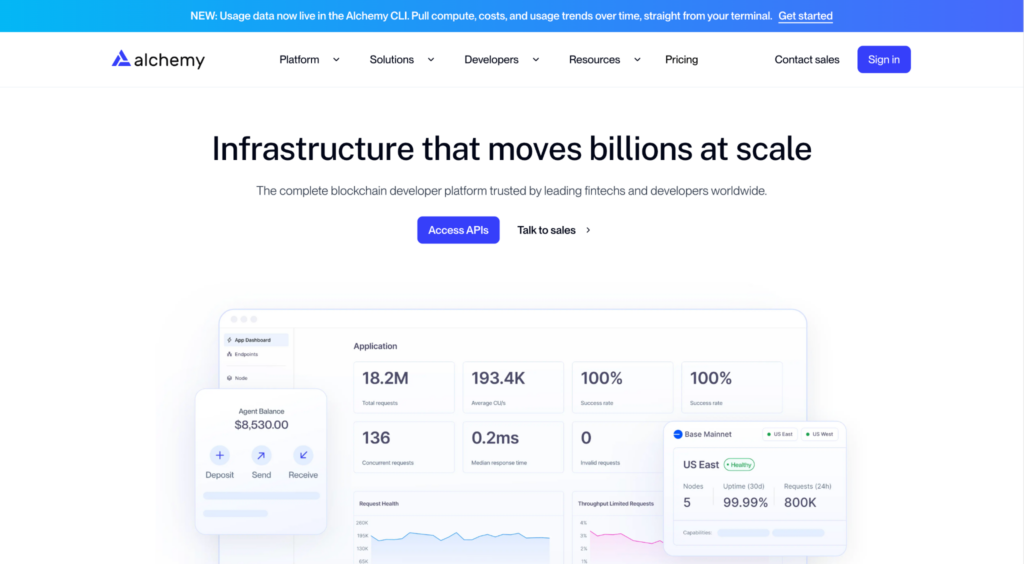
Once your product needs direct access to chain state, a price API is no longer enough. You need RPC infrastructure. Alchemy provides standard JSON-RPC and chain-specific APIs across 100+ networks, along with higher-level tools for tokens, NFTs, transfers, simulation, and wallet development.
What’s different about Alchemy? A market-data API tells you what ETH costs; an RPC provider lets your app query Ethereum, inspect a contract, subscribe to events, or submit a transaction.
Alchemy also ships an MCP server, so supported AI tools can work with live on-chain data and Alchemy’s API surface.
Chainstack and QuickNode are strong alternatives. Chainstack currently supports 70+ networks and offers its own MCP server. Compare the exact chains you need, archive access, WebSocket behavior, latency targets, regional routing, support, and cost at your expected request pattern.
Strengths
- Managed RPC access across 100+ networks
- Enhanced token, NFT, transfer, wallet, and simulation APIs
- Mature documentation, SDKs, and AI-agent tooling
- Suitable for both read and write interactions with supported chains
Tradeoffs
- It is unnecessary if your product only consumes prices or connected-account data.
- Costs can rise quickly with high request volume, archive data, WebSockets, or latency-sensitive workloads.
- Feature coverage varies by chain, so verify the exact API-and-network combination before committing.
Best for: wallets, dApps, on-chain trading systems, smart-contract products, and any application that must read or write chain state directly.
4. GoldRush by Covalent: best for structured multichain data
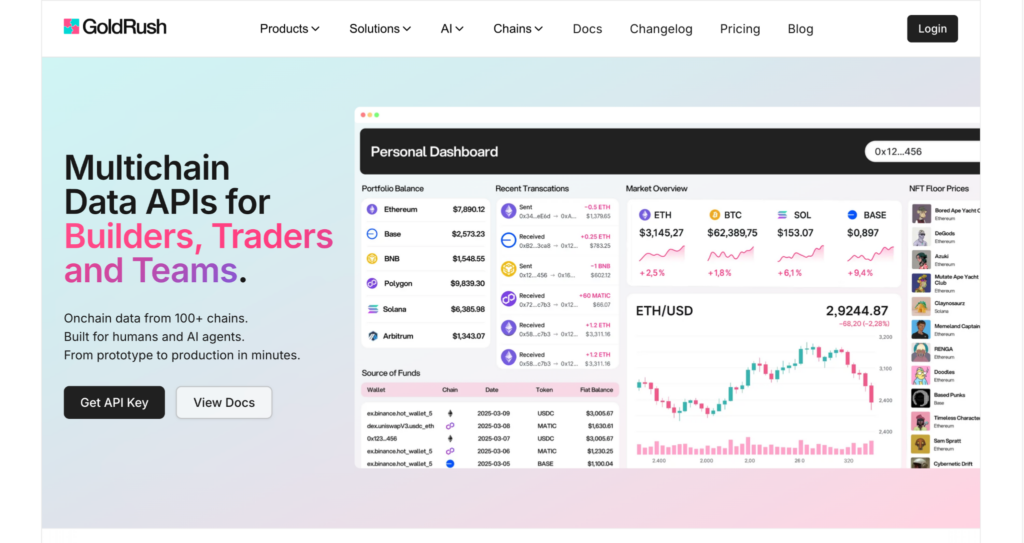
GoldRush, Covalent’s developer platform, sits between raw RPC and finished analytics. It returns structured wallet balances, transaction histories, NFT metadata, token prices, and DEX data across 100+ chains through a unified API.
The real value is not the chain count on its own. It is the amount of indexing and normalization your team does not have to build. Instead of parsing raw logs and maintaining separate data pipelines for each network, you can query a consistent service and focus on the product layer.
The Graph remains a strong alternative when you need a custom, protocol-specific data model through subgraphs. GoldRush is a better starting point when you want common wallet and transaction data across many networks without operating your own indexers.
Strengths
- Structured data across 100+ supported chains
- Wallet balances, full transaction history, NFTs, token prices, and DEX data in one platform
- A consistent API that reduces chain-by-chain indexing work
- Useful historical depth for analytics and data-pipeline workloads
Tradeoffs
- Endpoint and data coverage are not identical on every network. Verify the exact chain and dataset you need.
- For ultra-low-latency or chain-specific features, a native indexer or specialized chain API may be a better fit.
- Credit-based usage can be harder to forecast for large historical backfills or high-volume applications.
Best for: multichain dashboards, wallet analytics, NFT products, data pipelines, and teams that need structured on-chain history across a broad set of networks.
5. Glassnode: Best for Professional On-Chain Analytics
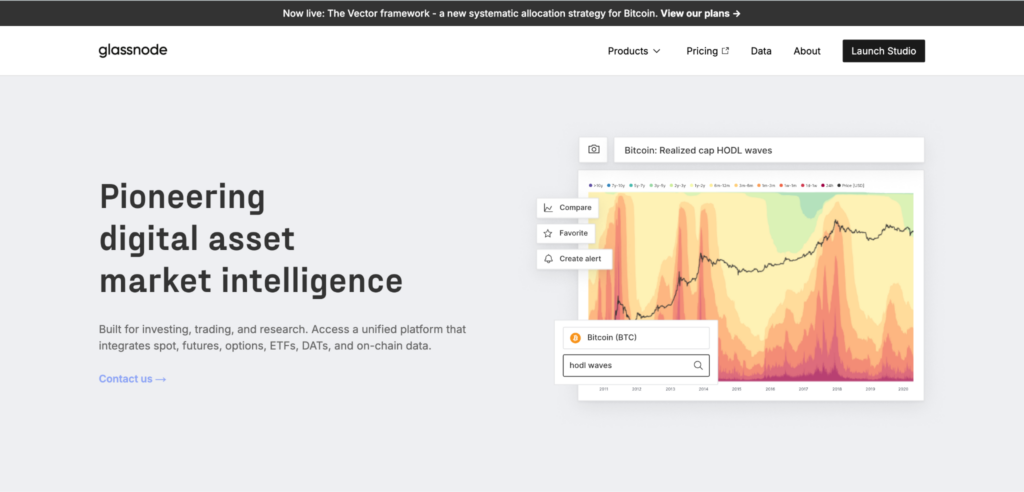
Most APIs give you balances and transactions but Glassnode gives you derived research metrics: realized cap, exchange flows, long-term-holder supply, miner revenue, and other signals used by analysts and quantitative teams.
Its entity-adjusted metrics use clustering methods to group addresses believed to belong to the same actor and filter activity that may be internal. Glassnode also offers point-in-time metric variants that preserve what was known at a historical moment, which can reduce look-ahead bias in backtests.
That sophistication comes with two cautions. Entity labels are estimates rather than ground truth, and some non-point-in-time series can change as clustering improves. API access is aimed at professional users and currently requires a Professional plan plus an API add-on. Glassnode’s MCP server is available in beta for AI-assisted research.
Strengths
- A large catalogue of curated on-chain and market metrics
- Entity-adjusted measures that aim to reduce address-level noise
- Point-in-time series for more defensible historical research
- Professional charting, API delivery, and an MCP server in beta
Tradeoffs
- Pricing and API access are designed for professional teams, not low-budget prototypes.
- Entity-adjusted data depends on statistical methods and should not be treated as perfect identification.
- It is not a substitute for user-level account aggregation or direct RPC access.
Best for: quant desks, asset managers, research teams, and analysts who need derived on-chain metrics and defensible historical datasets.
What About Exchange and Trading APIs?
If your product must place orders, manage positions, or move assets, go to the execution layer. Binance, Kraken, and Coinbase provide venue-specific trading APIs.
To trade across several venues through one interface, CCXT wraps more than 100 exchange APIs. You still run the library, manage credentials, handle venue differences, and maintain the integration.
Execution is a separate job from market data or account aggregation, so it sits outside the five-category ranking above.
Quick Comparison of the Best Crypto APIs for Developers
The table below brings the key differences together, making it easier to compare each API by its primary function, coverage, capabilities, and best use case.
| Vezgo | CoinGecko | Alchemy | Covalent | Glassnode | |
|---|---|---|---|---|---|
| Primary job | Account aggregation | Market data | RPC / infrastructure | Multi-chain on-chain data | On-chain analytics |
| Reads a user’s holdings | ✅ | ❌ | ❌ | By address | ❌ |
| Market prices | ❌ | ✅ | ❌ | Limited | Limited |
| Read/write chain state | ❌ | ❌ | ✅ | Read | ❌ |
| Derived analytics | ❌ | ❌ | ❌ | Limited | ✅ |
| Coverage | Dozens of exchanges, 100s of wallets | 17,000+ coins | Major chains | 200+ chains | BTC/ETH + majors |
| No private keys / SOC 2 | ✅ | n/a | n/a | n/a | n/a |
| MCP / AI-ready | AI-agents use case | ✅ | ✅ | — | ✅ |
| Best for | Reading user holdings | Prices | On-chain apps | Cross-chain data | Institutional research |
How To Choose A Crypto API For Your Project
The cryptocurrency ecosystem is exploding, and so are the APIs with which you can tap into its unlimited data and possibilities for your project. Let’s look into some things to consider when choosing one:
1. Number of Relevant Features
Emphasis on “relevant”!
Innovative features are great. They help you get the cryptocurrency API to do impressive things with ease. But here, more isn’t always better.
Many of the best APIs are paid. While some have free versions, you might have to pay to enjoy some features. And the more features an API has, the higher the price it goes for. So, why pay for a feature if you don’t need it?
We recommend you stick to a crypto API that has just the number of features you need, not the one that has features you may or may not need.
2. Capacity
Cryptocurrency APIs often have a maximum number of requests they can process simultaneously.
For instance, a crypto API for automating trades may only be able to handle 50 transactions at a time. So if your product has so many users that you easily crush the 50 transactions per second, you may need to turn to another API.
If your project is just in the early stages, the chances are that you don’t need an API that handles a lot of requests yet. But it makes sense to think ahead into the future and plan for an API that can handle your growing number of requests.
3. Ease of Use
“Keep It Simple, Stupid!”
That’s the KISS principle, and it applies to everything the developer does. But if a cryptocurrency API violates this principle, we advise you to tread carefully with such API.
The reason you’re using an API is to help you receive data from a service without having to code it. When the data comes, you want to be able to use, organize, and integrate it. The best APIs offer this. If an API makes this process complicated, consider using another API.
4. Update Frequency
When an API is constantly updated, it shows that the provider is interested in improving the API. This is good because you can concentrate on your project and trust the API provider to offer you the best and most improved tool.
However, if there are too many updates within a short period, this might be a negative sign. This is especially true if the update requires that the API goes offline for some time. Such APIs could do more harm than good to your product, as they could cause you to lose users due to constant downtimes.
5, Scalability
Every developer wants that project to grow, which is a good thing. But if your tools are not robust enough to handle your growth, it might be limiting for you and your project. Therefore, consider the crypto API’s robustness before using it in your project. And if it isn’t already so massively robust yet, research how likely it is to expand. If it has a history of expansions and upgrades, then there are chances they can scale with your business.
6. Pricing
Some API providers offer free pricing plans among their pricing packages. These free versions are often great for testing the API before investing too much in them. But for whichever API you want to go for, ensure you can keep up with the price of its paid versions.
Which Crypto API Should You Choose?
- Choose Vezgo when you need a user’s real balances, positions, and transaction history across connected exchanges and wallets.
- Choose CoinGecko when you need prices, market caps, token metadata, charts, or broad market coverage.
- Choose Alchemy when your application must read or write chain state directly.
- Choose GoldRush when you want structured wallet and transaction data across many chains without building every indexer yourself.
- Choose Glassnode when your research depends on derived on-chain metrics, entity-adjusted data, or point-in-time historical series.
Most serious products use more than one layer. A common fintech stack is Vezgo for holdings and CoinGecko for prices. An on-chain wallet might use Alchemy for RPC and GoldRush for indexed history. A research desk may combine Glassnode with a separate market feed. So, feel free to do whatever works for you here.
Final thoughts
Start with the question your product must answer, not the vendor with the longest feature page. Once you name the data layer, the shortlist gets much smaller.
The most expensive layer to get wrong is often account aggregation. Provider connections, consent flows, sync behavior, and normalized schemas become part of the product’s infrastructure. Choose that layer early and keep easier-to-replace services, such as market data, modular.
If your product needs to read a user’s holdings across exchanges and wallets, start with a Vezgo demo or request API access. If it does not, choose the specialist that owns the job you actually have.
Frequently Asked Questions about the Best Crypto APIs for Developers
Still weighing your options? Here are answers to some of the most common questions developers ask when choosing and combining crypto APIs.
What is the best blockchain API for developers?
It depends on the job. Use an RPC provider such as Alchemy or Chainstack to read or write chain state. Use GoldRush or The Graph for structured on-chain history. Use Vezgo to read a connected user’s holdings across exchanges and wallets. These products solve different layers, so there is no credible single winner.
Where can developers find reliable crypto APIs for fintech platforms?
Portfolio dashboards, tax tools, lending products, and compliance platforms often need account aggregation: real balances and transaction history across a user’s accounts. Vezgo is built for that read-only use case and it is SOC 2 Type II certified. Mesh is closer when the product must also transfer assets or execute transactions.
What is the best crypto portfolio tracking API?
Vezgo is the specialist choice for normalized holdings and transaction history across connected exchanges and wallets. CoinStats is worth considering when you want market data, wallet data, DeFi positions, and portfolio analytics from one vendor rather than pairing specialists.
Can one API provide both market prices and a user’s holdings?
Yes, but bundled coverage involves tradeoffs. CoinStats combines several data layers behind one API. The specialist approach is to pair Vezgo for connected holdings with CoinGecko for market prices. That creates two integrations, but each service is focused on its core job.



Leave a Reply