

Vezgo leads for financial data aggregation, while Alchemy and Infura lead for enterprise infrastructure reliability. QuickNode, Chainbase, Covalent, and Ankr each lead for a specific niche: speed, indexed data, historical analytics, or affordable entry. Arbitrum has become one of the most important blockchain networks for businesses building decentralized applications, payment platforms, trading products, analytics tools, and digital finance solutions. Strong developer adoption, lower transaction costs, and Ethereum compatibility have transformed it into a preferred network for institutions seeking scalable blockchain infrastructure.
Selecting the right Arbitrum API has become an important business decision, since API quality directly affects application performance, reliability, scalability, and customer experience. Several providers now offer access to the Arbitrum ecosystem, but their strengths differ significantly.
Some specialize in blockchain infrastructure, others focus on transaction indexing, while Vezgo provides complete financial data aggregation across exchanges, wallets, and blockchains. This guide compares seven providers on capabilities, pricing, advantages, and limitations. The table below gives the short version; full reviews follow.
TL;DR: Which Arbitrum API Should You Choose?
Vezgo leads for financial data aggregation. Alchemy and Infura lead for enterprise infrastructure reliability, and QuickNode, Chainbase, Covalent, and Ankr each lead for a specific niche: speed, indexed data, historical analytics, or affordable entry. Here’s the quick comparison before the full breakdown.
| Provider | Best For | Starting Price | Free Option |
| Vezgo | Financial data across Arbitrum + 300 other sources | Custom pricing | Free sandbox |
| Alchemy | Enterprise infrastructure reliability | ~$5 per 11M compute units | 30M compute units/month |
| QuickNode | Fast, globally distributed RPC | $49/month | 1-month trial |
| Infura | Ethereum-native development | $50/month | 3M credits/day |
| Chainbase | Indexed, query-ready blockchain data | $99/month | 200K credits/month |
| Covalent (GoldRush) | Historical blockchain analytics | $10/month | 14-day trial |
| Ankr | Affordable multi-chain RPC | Pay-as-you-go, ~$0.10/1M credits | 200M credits/month |
Methodology: How We Chose the Best Arbitrum APIs for Businesses
The right choice of Arbitrum API depends on five factors: data completeness, performance, scalability, security, and documentation. Every provider promises speed and reliability, but actual business requirements extend further.
1. Data Completeness
Many APIs return blockchain transactions only. Financial applications often need wallets, token balances, historical transfers, exchange accounts, NFTs, and portfolio information from multiple sources.
2. Performance
Applications handling real-time data require infrastructure capable of processing thousands of requests without noticeable latency, since downtime affects customer trust and revenue.
3. Scalability
Growth often arrives faster than expected. Enterprise-grade APIs should support increasing traffic without requiring major architectural changes.
4. Security
Security standards matter for financial products handling sensitive customer information. Encryption, authentication, monitoring, and compliance certifications like SOC 2 should all factor into the evaluation.
5. Documentation
Excellent documentation shortens development time and reduces engineering costs. Clear SDKs and practical examples help development teams move faster.
The 7 Top Arbitrum APIs for Businesses
Here are the best Arbitrum APIs for businesses:
1. Vezgo: Best Arbitrum API for Financial Applications
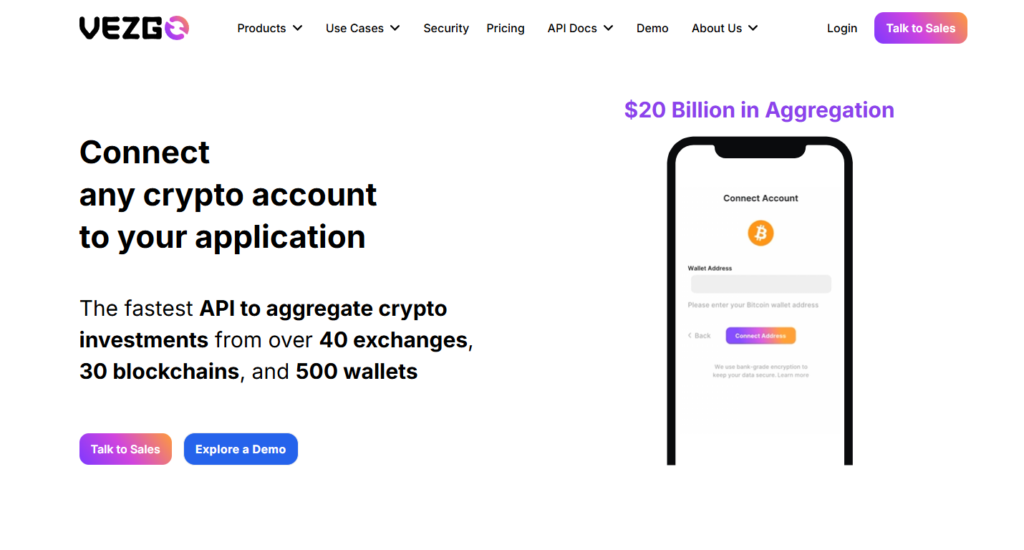
Vezgo is the strongest choice for businesses that need financial data aggregation across Arbitrum and hundreds of other exchanges, wallets, and blockchains, not raw blockchain infrastructure on its own. Businesses building financial platforms need much more than blockchain transactions. Customers expect complete visibility into their crypto holdings across exchanges, wallets, and blockchain networks, and that requirement places Vezgo in a unique category.
Unlike traditional RPC providers, Vezgo connects blockchain activity with exchange accounts and investment data through one standardized interface. This significantly reduces development effort for fintech companies, accounting platforms, wealth management applications, and tax software.
Vezgo supports 35 exchanges, 21 blockchains, and 300+ self-custody wallets through one standardized interface. Instead of building separate integrations for every exchange and wallet, development teams work with one consistent API. Vezgo’s own sister company, Wealthica, runs on this exact infrastructure, alongside more than 40 customers spanning investment trackers, tax software, and compliance tools.
Applications designed as portfolio trackers benefit especially from this unified architecture because customers rarely keep assets inside a single wallet or exchange.
Vezgo Key Features
- Unified API across exchanges, wallets, and blockchains
- Standardized transaction categories
- Historical portfolio information
- Fiat value conversion
- Webhook support
- SDKs for multiple programming languages
- SOC 2 Type II certified
- Broad crypto ecosystem coverage
Financial platforms looking for complete investment visibility also benefit from the Vezgo crypto data API, which combines blockchain information with account aggregation through one developer-friendly interface. Another major strength involves NFT support. Applications requiring NFT ownership information can integrate the Vezgo NFT API instead of building separate blockchain-specific NFT infrastructure.
Vezgo Pricing
| Plan | Pricing |
| Sandbox | Free |
| Production | Custom pricing |
| Enterprise | Custom pricing with dedicated support |
Vezgo Limitations
- Focuses on financial aggregation rather than raw blockchain infrastructure
- Not intended as a replacement for dedicated RPC nodes
- Enterprise pricing requires direct consultation
Vezgo Best For
- Wealth management platforms
- Accounting software
- Tax reporting applications
- Consumer finance products
- Investment dashboards
2. Alchemy: Best Enterprise Arbitrum API for High Reliability
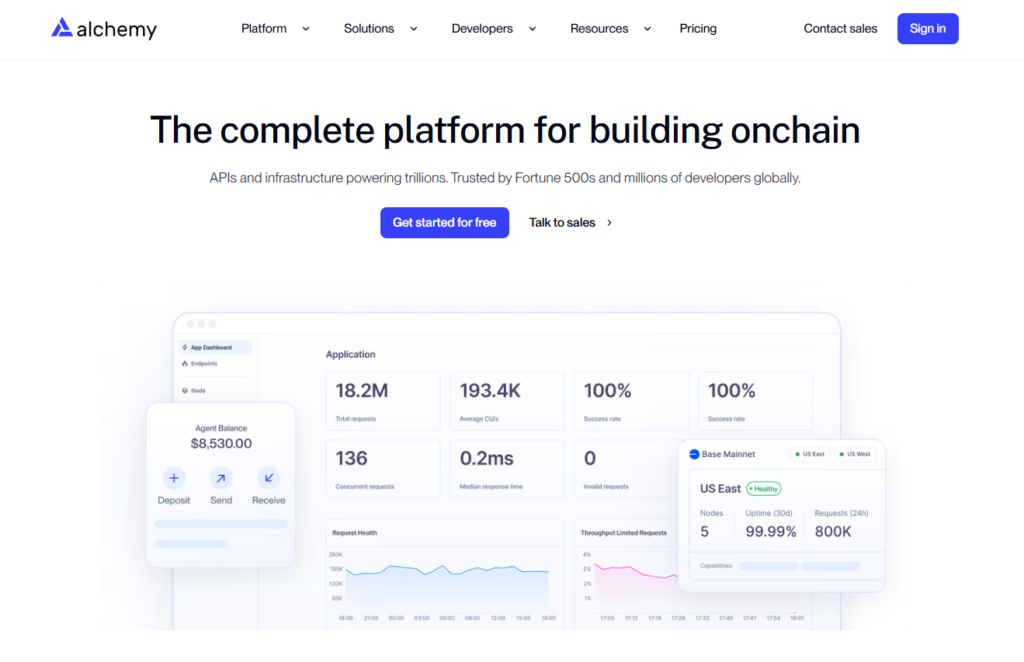
Alchemy is the strongest choice for large businesses that need infrastructure capable of supporting millions of blockchain requests every day. Its Arbitrum support includes RPC endpoints, enhanced APIs, developer monitoring, analytics, and advanced debugging tools.
Alchemy’s free tier includes 30 million compute units a month, the most generous among major providers. Paid usage is billed at $0.45 per million compute units for the first 300 million per month, then $0.40 per million after that, so heavier users pay a lower effective rate as they scale. Engineering teams appreciate the extensive documentation and mature ecosystem surrounding the platform, and diagnostic tools quickly identify performance bottlenecks before they affect production systems.
Applications interacting with smart contracts across Arbitrum also benefit from Alchemy’s extensive tooling.
Alchemy Main Features
- Highly available RPC infrastructure
- Enhanced blockchain APIs
- Debugging tools
- Transaction simulation
- Monitoring dashboard
- Webhooks
- Analytics
Alchemy Pricing
| Plan | Pricing |
| Free | 30M compute units/month |
| Pay as You Go | $0.45/1M CU (first 300M), then $0.40/1M CU |
| Enterprise | Custom pricing |
Alchemy Limitations
- Premium features become expensive as usage increases
- Advanced capabilities require higher-tier plans
- Financial aggregation is outside its primary focus
Alchemy Best For
Enterprise applications requiring dependable blockchain infrastructure.
3. QuickNode: Best Arbitrum API for Fast Blockchain Performance
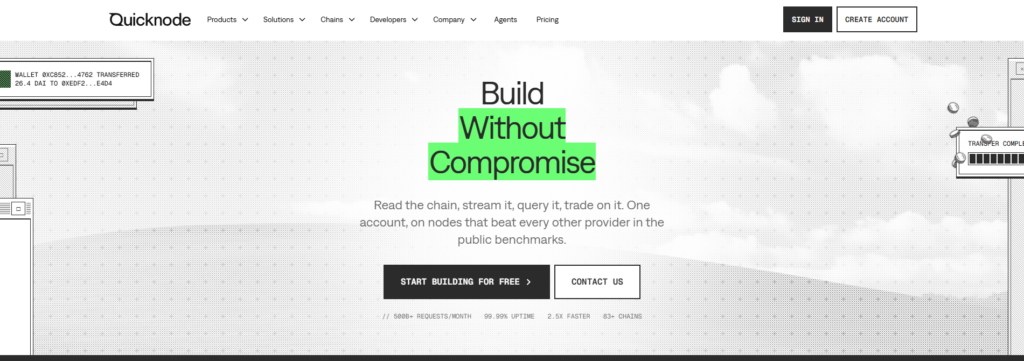
QuickNode is the strongest choice for businesses that want fast, globally distributed infrastructure with minimal setup time. Speed becomes a competitive advantage as blockchain applications grow, and QuickNode has earned a strong reputation for delivering fast response times through this global footprint.
Development teams frequently choose QuickNode because deployment takes only a few minutes and scaling remains straightforward. A one-month free trial (10 million credits, no credit card required) is available for testing, with paid plans starting at $49 a month, or $42 a month billed annually. Businesses launching new blockchain products can move from development into production quickly, and the global node network reduces latency for customers across multiple regions.
QuickNode Main Features
- Global node network
- High availability
- RPC endpoints
- Archive node access
- Websocket support
- Developer analytics
- Marketplace extensions
QuickNode Pricing
| Plan | Pricing |
| Free trial | 1 month, 10M credits |
| Build | $49/month ($42/month billed annually) |
| Scale | Higher usage pricing |
| Enterprise | Custom pricing |
QuickNode Limitations
- The free option is a one-month trial, not an ongoing free tier
- Costs increase with heavy request volume
- Financial account aggregation is unavailable
QuickNode Best For
Trading platforms, blockchain applications, gaming, and payment infrastructure.
4. Infura: Best Arbitrum API for Ethereum-focused Development
Infura is the strongest choice for teams already building on Ethereum who want the same provider for Arbitrum. The transition requires minimal additional learning. Owned by Consensys and serving as the default RPC provider for MetaMask, Infura has served Ethereum developers for many years and continues as a trusted infrastructure provider for Layer 2 networks such as Arbitrum.
The free tier includes 3 million daily credits at 500 credits per second. Paid tiers scale from Developer at $50 a month (15 million daily credits, 4,000 credits per second) up to Team at $225 a month (75 million daily credits, 40,000 credits per second), with custom Enterprise pricing above that. Documentation is comprehensive, the ecosystem is well-established, and integration with existing Ethereum projects is straightforward.
Infura Key Features
- Reliable Arbitrum RPC endpoints
- WebSocket support
- Archive node access
- Transaction broadcasting
- Event subscriptions
- Extensive documentation
- Enterprise infrastructure
Infura Pricing
| Plan | Pricing |
| Free | 3M credits/day, 500 credits/sec |
| Developer | $50/month, 15M credits/day |
| Team | $225/month, 75M credits/day |
| Enterprise | Custom pricing |
Infura Limitations
- Advanced plans become expensive for applications with very high request volumes
- Focuses primarily on blockchain connectivity instead of blockchain analytics
- Limited financial aggregation capabilities
Infura Best For
Ethereum developers expanding into Arbitrum applications.
5. Chainbase: Best Arbitrum API for Indexed Blockchain Data

Chainbase is the strongest choice for businesses that need structured, query-ready blockchain data instead of raw connectivity. Many businesses need more than blockchain connectivity. Analytics platforms often require indexed information that developers can query immediately instead of manually processing raw blockchain data.
Chainbase addresses this through indexed datasets and SQL-style queries. The free tier includes 200,000 credits a month at 3 credits per second, enough for evaluation. The Developer tier costs $99 a month for 10 million credits and 30 credits per second, a meaningful step up in both volume and throughput. Development teams can retrieve wallet activity, token transfers, contract events, and transaction histories without maintaining their own indexing infrastructure, which significantly reduces engineering complexity.
Chainbase Key Features
- Indexed blockchain datasets
- SQL-style blockchain queries
- Wallet analytics
- Token transfer history
- Contract event indexing
- Multi-chain support
Chainbase Pricing
| Plan | Pricing |
| Free | 200K credits/month |
| Developer | $99/month, 10M credits/month |
| Enterprise | Custom pricing |
Chainbase Limitations
- Not designed as a dedicated RPC infrastructure provider
- Some advanced datasets require premium plans
- Specialized enterprise datasets may require custom agreements
Chainbase Best For
Analytics platforms, blockchain intelligence products, research firms, and institutional reporting solutions.
6. Covalent (GoldRush): Best Arbitrum API for Historical Blockchain Analytics
Covalent, now marketed as GoldRush, is the strongest choice for businesses that need deep historical blockchain data across many networks including Arbitrum. Historical blockchain information plays a critical role in accounting platforms, compliance software, investment research, and business intelligence products.
Covalent specializes in collecting, indexing, and organizing blockchain history. A 14-day free trial includes 25,000 credits, with paid plans starting at $10 a month for indie developers (10,000 credits) and scaling to $250 a month for production use (300,000 credits, higher rate limits, auto-scaling). Instead of processing blockchain records manually, developers gain access to structured information through a unified interface.
Applications performing digital assets auditing benefit from Covalent because historical records remain easily accessible across extensive time periods.
Covalent Key Features
- Historical wallet data
- Token balances
- NFT ownership history
- Transaction indexing
- Unified multi-chain API
- Extensive blockchain coverage
Covalent Pricing
| Plan | Pricing |
| Free trial | 14 days, 25K credits |
| Vibe Coding | $10/month, 10K credits |
| Professional | $250/month, 300K credits |
| Enterprise | Custom pricing |
Covalent Limitations
- Designed primarily for indexed data instead of high-speed RPC requests
- Large-scale historical queries can consume credits quickly
- Premium enterprise support requires custom pricing
Covalent Best For
Compliance software, institutional research, accounting platforms, and blockchain analytics companies.
7. Ankr: Best Affordable Arbitrum API for Growing Businesses
Ankr is the strongest choice for startups that want a genuinely free entry point with room to grow. That’s a different value than a flat low-cost subscription. Budget constraints often shape infrastructure decisions during the early stages of product development, and Ankr has positioned itself as one of the most affordable blockchain infrastructure providers while maintaining dependable performance.
Ankr’s Public tier is free and rate-limited, and Freemium adds 200 million monthly API credits at no cost. Premium moves to pay-as-you-go pricing at roughly $0.10 per million credits, though heavier methods consume more credits per call, so the effective rate depends on usage patterns. Small businesses and startups frequently begin with Ankr because entry costs remain low while scalability continues to support business growth.
Ankr Key Features
- Multi-chain RPC endpoints
- Load balancing
- Global infrastructure
- API monitoring
- Archive node access
- Developer dashboard
Ankr Pricing
| Plan | Pricing |
| Public | Free, rate-limited |
| Freemium | Free, 200M credits/month |
| Premium | Pay-as-you-go, ~$0.10/1M credits |
| Enterprise | Custom pricing |
Ankr Limitations
- Advanced enterprise tooling is more limited than premium competitors
- Effective cost can be hard to predict since heavier methods use more credits per call
- Specialized analytics require third-party services
Ankr Best For
Startups, blockchain developers, and companies entering the Arbitrum ecosystem with limited infrastructure budgets.
Best Arbitrum APIs Compared
| API | Best For | Free Plan | Paid Pricing Starts | Primary Strength |
| Vezgo | Financial applications and data aggregation | Yes | Custom enterprise pricing | Unified crypto financial data |
| Alchemy | Enterprise blockchain infrastructure | Yes (30M CU/month) | $0.45/1M CU pay-as-you-go | Reliability and scalability |
| QuickNode | High-performance RPC services | 1-month trial | $49/month | Speed and global infrastructure |
| Infura | Ethereum and Layer 2 connectivity | Yes (3M credits/day) | $50/month | Mature developer ecosystem, MetaMask backend |
| Chainbase | Indexed blockchain data | Yes (200K credits/month) | $99/month | Query-ready blockchain datasets |
| Covalent (GoldRush) | Historical blockchain analytics | 14-day trial | $10/month | Rich historical blockchain data |
| Ankr | Affordable RPC infrastructure | Yes (200M credits/month) | Pay-as-you-go, ~$0.10/1M credits | Cost-effective blockchain access at scale |
Essential Features Every Business Should Compare Before Choosing an Arbitrum API
Reliability, scalability, documentation, pricing transparency, support, multi-chain readiness, and data coverage matter most when comparing providers. Selecting an API becomes much easier after weighing the capabilities that have the greatest long-term impact.
1. Reliability
Infrastructure outages interrupt customer activity and damage trust. Enterprise providers invest heavily in redundancy, monitoring, and global availability to minimize downtime.
2. Scalability
Successful applications often grow rapidly. Infrastructure should support increasing transaction volumes without requiring a complete migration to another provider.
3. Documentation Quality
Clear documentation shortens development cycles, reduces implementation mistakes, and lowers maintenance costs throughout the product lifecycle.
4. Pricing Transparency
Straightforward pricing allows businesses to forecast operational costs accurately. Hidden fees and complicated usage calculations create budgeting challenges, as the gap between Ankr’s headline $0.10 rate and its effective per-request cost shows.
5. Customer Support
Fast technical assistance becomes valuable during production incidents. Enterprise support often includes dedicated engineers, priority response times, and architectural guidance.
6. Multi-Chain Expansion
Many businesses eventually expand beyond Arbitrum. Providers supporting multiple blockchain networks reduce future migration effort and simplify infrastructure management.
7. Data Coverage
Some APIs provide blockchain transactions only. Others include wallet information, token holdings, NFTs, historical activity, and balances and positions, making them far more valuable for financial products.
Features Every Enterprise Arbitrum API Should Include
High availability, strong security, clear documentation, flexible scaling, and event notifications are the five capabilities that separate enterprise-ready platforms from basic infrastructure. Strong enterprise platforms normally include the following.
1. High Availability Infrastructure
Reliable uptime protects customer experience and prevents revenue loss. Infrastructure should continue operating even during periods of heavy blockchain activity.
2. Strong Security Standards
Business applications require encryption, authentication, monitoring, and secure access controls. Security cannot become an afterthought.
3. Developer Friendly Documentation
Clear documentation reduces implementation time and lowers maintenance costs throughout the life of the application.
4. Flexible Scaling
Growing businesses should avoid rebuilding infrastructure after customer demand increases. Elastic scaling protects future growth.
5. Event Notifications
Webhook support allows applications to respond immediately when blockchain activity occurs instead of repeatedly requesting new information.
Some financial platforms also simplify customer onboarding through a connect flow widget, reducing development effort while improving the overall user experience.
Why Pricing Alone Should Never Determine Your Decision
Total operational cost, including engineering time and maintenance, usually matters more than the monthly subscription fee. Lower monthly costs often appear attractive during the early stages of development, but long-term expenses frequently depend more on engineering time, maintenance, scalability, and operational reliability than subscription fees.
An inexpensive API requiring multiple supplementary services may ultimately cost far more than an enterprise solution providing everything through one platform. Business leaders should evaluate total operational value instead of monthly subscription cost alone.
Blockchain businesses processing large transaction volumes also benefit from providers capable of supporting healthy liquidity in crypto markets, since infrastructure stability directly affects trading performance and customer satisfaction.
Final Verdict: Choosing the Best Arbitrum API for Your Business
For financial applications needing aggregated data across exchanges and wallets, Vezgo delivers the most long-term value. For raw blockchain infrastructure, Alchemy, Infura, QuickNode, and Ankr are all strong choices depending on budget and reliability needs. Chainbase and Covalent lead instead if the priority is indexed or historical data. Arbitrum has matured into one of the strongest blockchain ecosystems available today, and businesses entering the network now have access to infrastructure supporting everything from decentralized finance platforms to institutional investment products.
Vezgo delivers exceptional value for financial applications that need aggregated crypto information across exchanges, wallets, and blockchains. Alchemy remains one of the strongest choices for enterprise infrastructure requiring high reliability and advanced developer tools, while QuickNode offers impressive speed and global performance for customer-facing applications.
Infura continues to provide dependable Ethereum-compatible infrastructure for established development teams. Chainbase simplifies blockchain analytics through indexed datasets, and Covalent excels at historical blockchain intelligence and compliance-focused applications. Ankr provides the most affordable entry point for startups seeking dependable blockchain connectivity.
The strongest long-term decision comes from matching business objectives with a provider’s core strengths instead of selecting the lowest monthly subscription. Infrastructure decisions influence application performance, development speed, customer satisfaction, and future scalability.
Frequently Asked Questions About Arbitrum APIs for Businesses
Here are some of the most commonly asked questions about the best Arbitrum APIs for Businesses:
What is the best Arbitrum API for businesses?
It depends on the use case. Vezgo is the strongest choice for financial data aggregation across Arbitrum and hundreds of other sources. Alchemy and Infura lead for enterprise-grade raw infrastructure, and Chainbase or Covalent lead if the priority is indexed or historical data.
How much do Arbitrum APIs cost for businesses?
Most providers offer a free tier or trial, with paid plans commonly starting between $10 and $99 a month depending on the provider and enterprise pricing customized by volume. Vezgo prices Production and Enterprise deployments through custom quotes rather than public tiers.
Is Vezgo an Arbitrum RPC provider?
No. Vezgo is a financial data API that includes Arbitrum alongside 35 exchanges, 21 blockchains, and 300+ self-custody wallets. Businesses that need raw RPC or node-level access should pair Vezgo with a dedicated provider like Alchemy, Infura, or QuickNode.
Which Arbitrum API has the best free tier?
Ankr’s Freemium tier is the most generous at 200 million credits a month, followed by Alchemy at 30 million compute units a month. QuickNode’s free option is a one-month trial rather than an ongoing tier.
What security certifications should a business Arbitrum API have?
SOC 2 is the most commonly requested certification. Vezgo carries SOC 2 Type II; Alchemy, Ankr, and other providers should be confirmed directly if certification is a hard requirement.
Do I need a dedicated RPC provider if I already use Vezgo?
Yes, if the application needs blockchain infrastructure like node access or transaction submission. Vezgo handles standardized financial data aggregation, not RPC infrastructure.



Leave a Reply