


For institutions building on Solana, the right API choice depends on whether the priority is raw blockchain infrastructure or standardized financial data. Solana now processes roughly 100 million transactions a day and generates roughly 1TB of new chain data daily. Institutional infrastructure has to keep pace with that volume without dropping requests or introducing delay. Selecting the right Solana API has a direct impact on performance, security, scalability, compliance, and the overall user experience.
This guide compares the leading Solana API providers for institutions, including Vezgo, Helius, QuickNode, Chainstack, Alchemy, and Triton One, and explains where each one earns its place. The table below gives the short version; the sections that follow go deeper on each provider.
TL;DR: Which are the Best Solana APIs for Institutions?
Vezgo leads for financial data aggregation, Helius and Triton One lead for Solana-specific infrastructure, and QuickNode, Chainstack, and Alchemy lead for multi-chain coverage. Here’s the quick comparison before the full breakdown.
| Provider | Best For | Starting Price | Free Option |
| Vezgo | Financial data across Solana + 300 other sources | Custom enterprise pricing | Free trial |
| Helius | Solana-specific infrastructure and NFT data | $49/month | 1M credits/month |
| QuickNode | Multi-chain coverage (60+ networks) | $49/month | 1-month trial |
| Chainstack | Managed infrastructure across 70+ chains | $49/month | 3M requests/month |
| Alchemy | Multi-chain teams wanting the largest free tier | ~$5 per 11M compute units | 30M compute units/month |
| Triton One | Ultra-low-latency trading and MEV | Pay-as-you-go, $125 minimum deposit | Not applicable |
Why Do Institutions Need Enterprise-Grade Solana APIs?
Public Solana endpoints work for prototypes, but they cap out fast under real production load. Public nodes are typically limited to somewhere between 100 and 200 requests per second per IP address. They come with no service-level agreement and share resources with every other user hitting the same endpoint. Institutional platforms need infrastructure that holds up during periods of high network activity, since a trading platform, custodian, or payment gateway can’t tolerate a dropped transaction during a volume spike.
An enterprise Solana API solves this through dedicated infrastructure, advanced indexing, reliable support, enhanced monitoring, and clear uptime commitments, often 99.99% or better. Instead of spending engineering time maintaining blockchain nodes, development teams can focus on the product itself.
Data quality matters just as much as raw access. Many financial applications combine blockchain information with account management, reporting, compliance, and analytics. High-quality APIs simplify this by delivering standardized data that fits into existing systems instead of raw, unparsed blockchain responses that still need to be decoded and labeled.
Methodology: How Should Institutions Choose a Solana API?
The right choice depends on five factors: reliability, scalability, security, developer experience, and data coverage. Every institution weighs these differently. But they consistently separate enterprise-ready platforms from basic infrastructure services.
1. Infrastructure Reliability
Reliable infrastructure reduces downtime and keeps applications responsive during periods of heavy blockchain activity. Multiple geographic regions, automatic failover, and high-availability architecture provide the stability institutions expect, typically backed by an explicit uptime SLA rather than a best-effort promise.
2. Scalability
Transaction volumes rarely stay constant. A provider should handle increasing workloads without introducing delays, and its pricing model should scale predictably rather than surprising a growing team with a large bill.
3. Security Standards
Institutional platforms handle valuable financial information, so strong authentication, encrypted communication, detailed access controls, and independent security audits matter. SOC 2 Type II and ISO 27001 certification are the two credentials institutional buyers ask for most often.
4. Developer Experience
Clear documentation, SDKs, sample applications, and responsive technical support all reduce development time meaningfully.
5. Data Coverage
Many institutional products need more than raw transaction history. Account information, token metadata, historical records, analytics, and blockchain events all strengthen the foundation for an enterprise application.
The Best Solana APIs for Institutions
Vezgo leads for institutions building financial products, while Helius, QuickNode, Chainstack, Alchemy, and Triton One lead for teams that need blockchain infrastructure specifically. Here’s where each one fits.
1. Vezgo
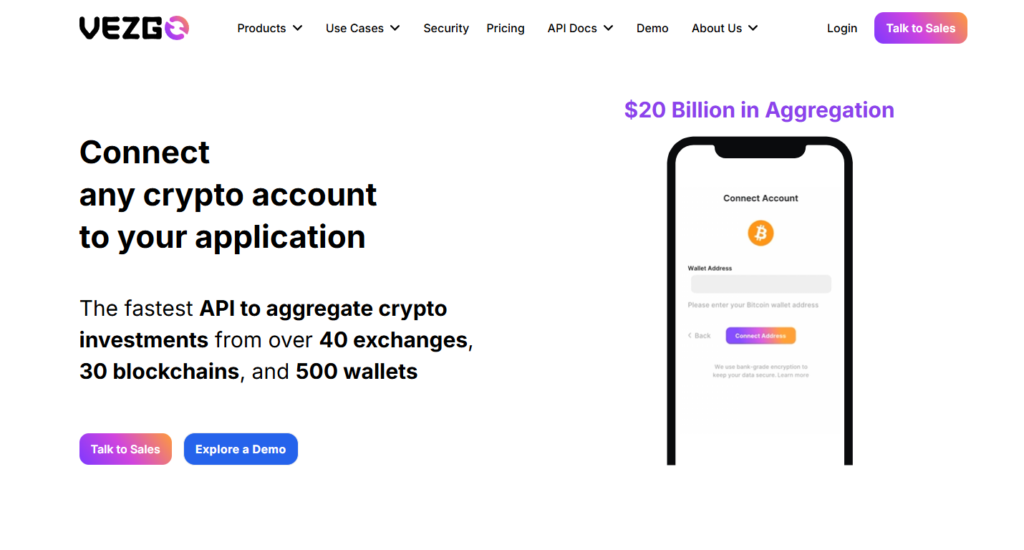
Vezgo is the strongest choice for institutions that need standardized financial data across Solana and hundreds of other exchanges, wallets, and blockchains. That’s a different job than raw Solana infrastructure on its own. For wealth management platforms, digital asset reporting tools, and investment products, that distinction matters more than raw node access.
This becomes especially valuable as institutional products expand beyond a single blockchain. Most organizations eventually manage data from multiple ecosystems, and unified access through one API is considerably more efficient than maintaining a separate integration for each one.
An investment platform, for example, often needs wallet information, exchange accounts, historical transactions, and account summaries inside one consistent structure. The Vezgo crypto data API normalizes that information across 35 exchanges, 21 blockchains, and 300+ self-custody wallets, reducing engineering complexity considerably compared to integrating each source individually.
Institutions also benefit from simplified onboarding. Vezgo’s connect flow widget lets users securely link supported exchanges and wallets through a guided interface, cutting development effort while keeping the experience professional.
Organizations building wealth dashboards, reporting platforms, or portfolio trackers get standardized data that simplifies aggregation across dozens of digital asset sources at once. Wealthica itself, Vezgo’s own sister company, runs on this exact infrastructure, alongside portfolio trackers like Merlin Investor and Exirio, and crypto tax platforms like Awaken Tax and SoftLedger.
NFT support is another differentiator. Investment firms increasingly manage NFT collections alongside traditional crypto holdings. The Vezgo NFT API delivers that data in the same structure as the rest of a user’s portfolio.
On security, Vezgo is SOC 2 Type 2 compliant, encrypts data with AES-256, and complies with PIPEDA and GDPR, the same standards a financial institution would expect from any core vendor.
Vezgo Pricing
Vezgo offers a free trial for evaluation before moving into production. Commercial pricing is customized by connected account volume, data requirements, support level, and deployment scale, which suits financial institutions well since infrastructure needs vary so much between organizations.
Vezgo Limitations
- Not designed to replace a dedicated Solana RPC provider
- Institutions building blockchain infrastructure, validator services, or node-level applications still need a specialized RPC provider alongside it
- Helius, QuickNode, Chainstack, Alchemy, and Triton One are all reasonable pairings depending on the workload
2. Helius
Helius is the strongest specialist for institutions building exclusively on Solana who need deep, chain-specific tooling. It combines RPC access with enhanced transaction parsing, webhook support, compressed NFT infrastructure, and indexing built specifically for Solana rather than adapted from a multi-chain platform.
Helius transforms raw blockchain information into structured responses, which simplifies blockchain interactions for financial platforms that would otherwise need to parse that data themselves. Its free tier includes 1 million credits a month at 10 requests per second, enough for prototypes and small tools. Paid tiers scale from a Developer plan around $49 a month, with 10 million credits and 50 requests per second, up to Business and Professional tiers in the $499 to $999 a month range. Dedicated nodes start near $2,900 a month for teams that need them.
Helius Pricing
Helius uses a credit-based model across four public tiers, Free, Developer, Business, and Professional, plus custom enterprise pricing for large-scale deployments. Add-on data services like enhanced streaming are priced separately from the base credit allowance.
Helius Limitations
- Focuses almost entirely on the Solana ecosystem
- Institutions planning to support additional blockchain networks will likely need a second provider alongside it
- Some enhanced APIs and streaming capabilities are reserved for paid tiers, so the free plan isn’t suitable for production workloads on its own
3. QuickNode
QuickNode is the strongest fit for institutions that need one infrastructure provider across many blockchains, Solana included, rather than a Solana specialist. It supports 60 or more networks alongside Solana. Large financial organizations value that breadth when they need to deploy across multiple chains without managing separate vendors for each.
QuickNode supports high request volumes while offering analytics, endpoint management, monitoring tools, and premium support. A one-month free trial is available for development and testing, with paid plans starting at $49 a month (or $42 a month billed annually) and scaling based on throughput, request volume, and add-on services like NFT data APIs and MEV protection.
QuickNode Pricing
QuickNode’s pricing is based on request volume, data transfer, and optional add-ons rather than a single flat rate, so the effective cost depends heavily on usage pattern. Enterprise pricing is customized for large-scale deployments.
QuickNode Limitations
- The free option is a one-month trial, not an ongoing free tier like Helius or Chainstack offer
- Throughput caps on standard tiers can matter for latency-sensitive Solana workloads
- Some advanced Solana-specific features require paid add-ons rather than coming included by default
- Institutions experiencing rapid growth should model request volume carefully, since costs can climb quickly as usage scales
4. Chainstack
Chainstack is a strong fit for institutions that want managed blockchain infrastructure without operating their own validator nodes, across 70 or more chains. Its enterprise platform includes dedicated nodes, elastic infrastructure, monitoring, and strong availability guarantees. All of it is backed by SOC 2 Type II and ISO 27001 certification.
Financial institutions appreciate the predictable performance, particularly for trading applications, settlement systems, custody solutions, and payment platforms. Chainstack also simplifies deployment across multiple cloud providers, which reduces operational complexity as an institution scales.
Chainstack Pricing
Chainstack’s free developer tier includes roughly 3 million requests a month, enough for early testing. Paid plans start in the neighborhood of $49 a month for a mid-tier allowance, with dedicated node deployments running into the low thousands of dollars a month depending on configuration; enterprise customers receive custom pricing based on infrastructure and cloud requirements.
Chainstack Limitations
- The free plan is intended for development work rather than production traffic
- Dedicated nodes, enhanced availability, premium support, and enterprise service commitments all require a higher subscription tier
- Organizations needing very high transaction throughput should plan for enterprise-tier infrastructure from the start
5. Alchemy
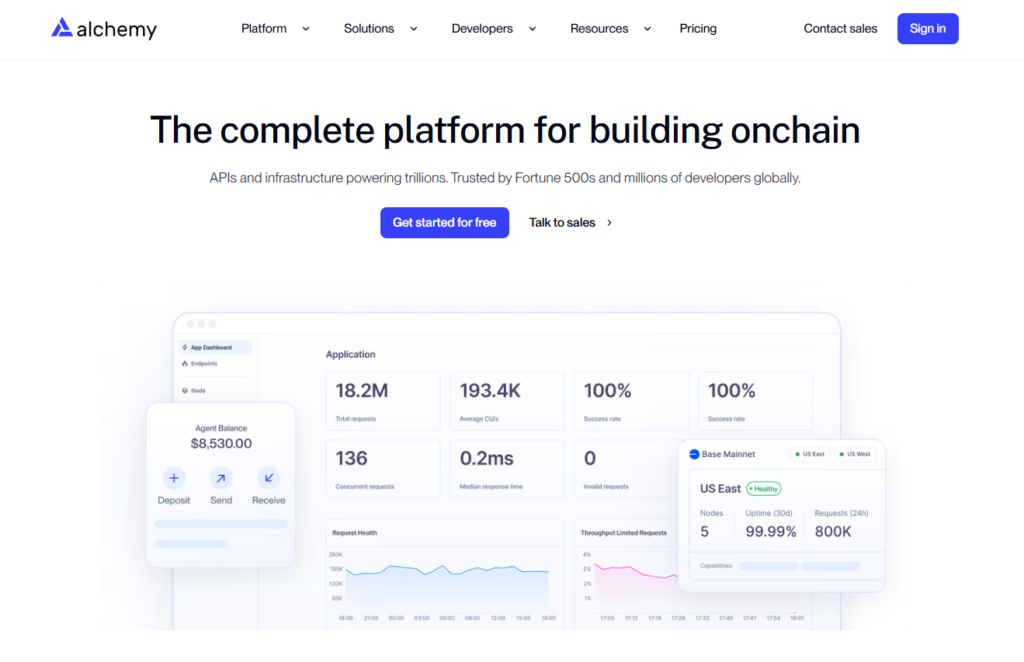
Alchemy is the strongest choice for institutions already standardized on Alchemy for other chains who want Solana support under the same account. It combines Solana RPC infrastructure with the extensive developer tooling Alchemy is known for across more than 70 blockchain networks in total.
Alchemy’s Solana services include enhanced RPC infrastructure, analytics, debugging tools, monitoring, and application management. Its free tier is the most generous among major providers, around 30 million compute units a month, which makes it a common starting point for teams evaluating multiple providers side by side. Alchemy already powers Solana-facing products at Phantom, Solflare, and Robinhood, among others.
Alchemy Pricing
Alchemy prices paid usage per compute unit, starting around $5 per 11 million compute units, with volume discounts at higher tiers. Enterprise customers negotiate custom agreements that typically include dedicated account management.
Alchemy Limitations
- Solana-specific optimization isn’t as deep as a Solana-only specialist like Helius or Triton One
- Some sources note it lacks the SOC 2 certification that Chainstack and QuickNode carry, worth confirming directly if that’s a hard requirement for your compliance process
6. Triton One
Triton One is the strongest choice for institutions running latency-sensitive trading, market-making, or MEV workloads where milliseconds affect outcomes. It specializes heavily in Solana infrastructure and created Yellowstone gRPC, a streaming technology now used as a reference point across the industry.
The platform offers premium RPC endpoints, validator services, enhanced networking, and infrastructure built specifically for demanding Solana workloads. Organizations involved in trading, market making, and staking prioritize the low-latency connections Triton One is built around, since consistent access to real-time data becomes more valuable as competition in decentralized finance increases.
Triton One Pricing
Triton One prices differently from the other providers here: instead of monthly subscription tiers, it uses pay-as-you-go billing. A $125 minimum deposit, prepaid, non-refundable, and valid for 12 months, unlocks full access to all features across Solana, Monad, and Sui. After that, standard RPC and ledger queries cost $0.08 per GB of bandwidth plus $10 per million calls, with separate metered rates for streaming and Metaplex API usage. A separate dedicated node option is also available for teams that need isolated infrastructure.
Triton One Limitations
- Specializes heavily in Solana, so organizations supporting many blockchain ecosystems will likely need additional providers for broad coverage
- Pricing is customized rather than published, so smaller organizations may find early budgeting more difficult than with a provider that lists fixed tiers
Feature Comparison of the Leading Solana APIs
Vezgo leads on financial data standardization and multi-platform coverage. Helius and Triton One lead on Solana-specific infrastructure depth instead. The table below summarizes where each provider is strongest.
| Provider | Best For | Free Tier | Paid Plans Start Around | Key Certifications |
| Vezgo | Financial data across Solana + 300 other sources | Free trial | Custom enterprise pricing | SOC 2 Type 2, PIPEDA, GDPR |
| Helius | Solana-specific infrastructure and NFT data | 1M credits/month | $49/month | Not publicly listed |
| QuickNode | Multi-chain coverage (60+ networks) | 1-month trial | $49/month | SOC 2, ISO 27001 |
| Chainstack | Managed infrastructure across 70+ chains | 3M requests/month | $49/month | SOC 2 Type II, ISO 27001 |
| Alchemy | Multi-chain teams wanting the largest free tier | 30M compute units/month | ~$5 per 11M CU | Not publicly listed |
| Triton One | Ultra-low-latency trading and MEV | Not applicable | Pay-as-you-go, $125 minimum deposit | Not publicly listed |
Which Institutions Benefit Most from Enterprise Solana APIs?
Wealth managers, custodians, exchanges, analytics providers, and compliance teams all rely on enterprise Solana APIs, each for a different reason. Different industries place different demands on the infrastructure.
1. Wealth Management Platforms
Investment firms increasingly support crypto alongside traditional investments. Standardized blockchain data simplifies reporting while improving the client experience.
2. Digital Asset Custodians
Custodians require reliable blockchain access, transaction monitoring, security, and infrastructure capable of supporting institutional-scale operations.
3. Crypto Exchanges
Exchange platforms process significant blockchain traffic every day. High-availability infrastructure helps maintain smooth deposits, withdrawals, and settlement.
4. Financial Analytics Providers
Analytics platforms transform blockchain activity into market intelligence. Rich, indexed datasets simplify reporting and support institutional research.
5. Compliance Platforms
Regulated organizations increasingly perform digital assets auditing as part of internal governance and regulatory obligations. High-quality blockchain data supports accurate reporting and stronger compliance outcomes.
What Enterprise Features Separate Premium Solana APIs?
Institutional buyers often see similar raw performance numbers across providers; the real difference shows up in the enterprise capabilities layered on top. Five capabilities matter most.
Dedicated Support Teams
Large organizations expect direct access to technical specialists who understand enterprise deployments and production environments, not a shared support queue.
Service Level Agreements
A clear SLA, often 99.99% uptime or better among the providers compared here, gives predictable availability and reduces business risk.
Advanced Monitoring
Detailed dashboards, usage metrics, latency reports, and operational alerts help engineering teams keep production systems healthy.
Global Infrastructure
Distributed infrastructure reduces latency and improves availability for organizations serving customers across multiple regions.
Security and Compliance
Institutional platforms increasingly evaluate encryption standards, authentication methods, audit capabilities, and certifications like SOC 2 Type II or ISO 27001 before selecting a provider. Many organizations building decentralized finance platforms also integrate smart contracts, which makes secure infrastructure a requirement throughout the development lifecycle rather than an afterthought.
Choosing the Best Solana API for Institutions
For blockchain infrastructure specifically, Helius, QuickNode, Alchemy, Chainstack, or Triton One are all strong choices depending on technical priorities. For financial products spanning multiple exchanges and blockchains, Vezgo delivers more long-term value. Infrastructure quality shapes customer experience, operational efficiency, compliance, and how easily a platform can expand later.
Vezgo’s standardized financial data, 300-plus source coverage, and enterprise-focused security posture reduce development complexity for wealth management platforms, reporting tools, and investment products in particular. As institutional adoption grows and liquidity in crypto markets continues to evolve, choosing a provider that can grow alongside the business is one of the more consequential technology decisions an institution will make.
Frequently Asked Questions About Solana APIs for Institutions
Find answers here to questions you may have about Solana APIs for institutions
What is the best Solana API for institutions?
It depends on the use case. Vezgo is the strongest choice for institutions needing standardized financial data across Solana and hundreds of other sources. Helius and Triton One are the strongest choices for teams needing deep, Solana-specific infrastructure.
How much do Solana APIs cost for institutions?
Most providers offer a free tier for testing, with paid plans commonly starting around $49 a month and enterprise pricing customized by volume and support requirements. Vezgo typically prices institutional deployments through custom quotes, while Triton One uses pay-as-you-go billing with a minimum deposit rather than fixed monthly tiers.
Is Vezgo a Solana RPC provider?
No. Vezgo is a financial data API that includes Solana alongside more than 300 other exchanges, wallets, and blockchains. Institutions that need raw RPC or node-level access should pair Vezgo with a dedicated provider like Helius or QuickNode.
Do I need a dedicated RPC provider if I already use Vezgo?
Yes, if the application needs blockchain infrastructure like node access, validator services, or transaction submission. Vezgo handles standardized financial data aggregation, not RPC infrastructure.
Which Solana API has the best free tier?
Alchemy’s free tier is currently the most generous among major providers, at roughly 30 million compute units a month. Helius and Chainstack also offer ongoing free tiers for testing and small projects, while QuickNode offers a one-month free trial rather than a permanent free tier.
What security certifications should an institutional Solana API have?
SOC 2 Type II and ISO 27001 are the two most commonly requested by institutional buyers. Chainstack and QuickNode both carry these; Vezgo carries SOC 2 Type 2 along with PIPEDA and GDPR compliance.



Leave a Reply