

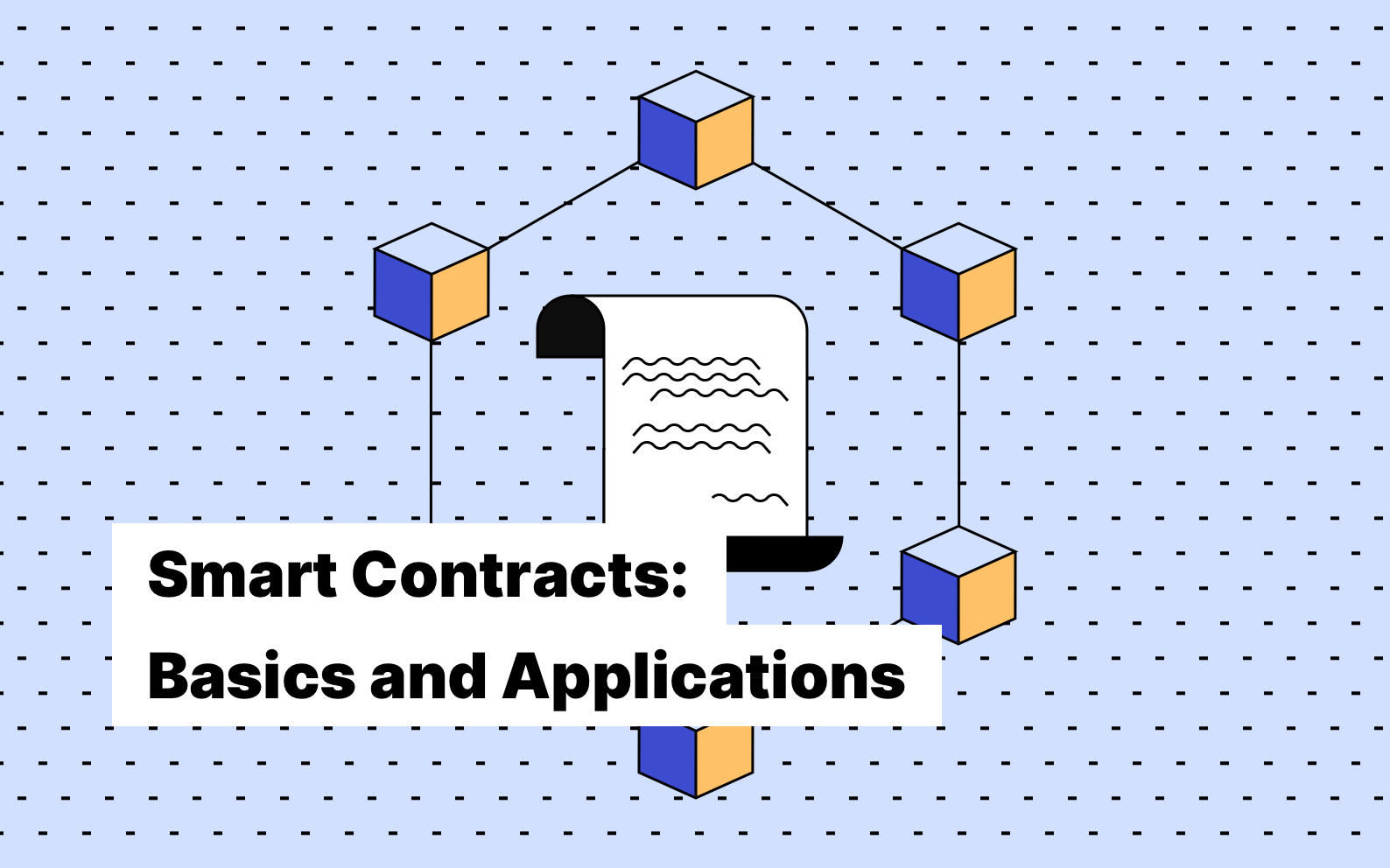
Think of a world where you can conduct business without needing to trust or even know the other party. This is the power of smart contracts—self-executing agreements that operate on the blockchain, eliminating intermediaries and automating transactions. Once deployed, the contract executes the same way every time, without waiting on a bank, broker, or lawyer to verify a step.
The global smart contracts market sat at roughly $2.69 billion in 2025 and is projected to reach $3.39 billion in 2026 on its way to $16.31 billion by 2034, per Fortune Business Insights. That growth is driven by real adoption across finance, supply chains, healthcare, real estate, and digital identity.
This guide walks through what smart contracts are, how they work, where they shine, where they fall short, and which industries are using them at scale today.
What are Smart Contracts?

Smart contracts are blockchain-based programs that execute automatically when predefined conditions are met. Investopedia defines them as self-executing programs that automate the actions required in a blockchain transaction. The terms live in code instead of paper, and the blockchain enforces them.
Picture hiring a freelance graphic designer. In a traditional setup, you pay a deposit, wait for the work, and then release the rest by bank transfer. Each step depends on trust or a third party. With a smart contract, you lock the full payment into the contract upfront. When the designer uploads the verified file, the contract releases payment. If the deadline passes, the deposit returns to you. No chasing, no escrow service, no dispute window.
That same logic scales to billion-dollar use cases. BlackRock’s tokenized money market fund BUIDL grew to roughly $2.9 billion in total value by late 2025, with smart contracts handling distributions and compliance. Decentralized applications, DeFi lending protocols, and tokenized treasuries all run on the same primitive.
How Do Smart Contracts Work?

A smart contract works by checking input conditions against rules written in its code, then executing predefined actions when those conditions match. Three components make this possible: the blockchain that hosts the code, the oracle that supplies real-world data, and the gas fee that pays for execution. Each plays a distinct role.
1. The Blockchain
The blockchain stores the contract code and records every action it takes. When someone sends a transaction to the contract, network validators run the code, verify the result, and write the outcome to the public ledger. This process runs through blockchain nodes that confirm each step. Once recorded, the transaction cannot be reversed or hidden, which is why blockchains are a strong substrate for binding agreements.
2. The Oracle
Smart contracts cannot read the outside world on their own. They rely on oracles, which are services that fetch off-chain data and post it to the blockchain in a verifiable form. A weather contract needs a weather oracle. A flight delay insurance contract needs a flight status oracle. Decentralized oracle networks like Chainlink aggregate multiple data sources, which prevents a single failed feed from breaking the contract.
3. The Gas Fee
Every smart contract operation consumes computational resources, and those resources cost gas. On Ethereum, gas is paid in ETH and varies with network congestion. Simple transfers cost less. Complex multi-step contracts cost more. Layer 2 scaling solutions such as Arbitrum, Optimism, and Base have reduced typical gas costs to fractions of a cent on most transactions, making everyday smart contract usage practical.
What Are the Benefits of Smart Contracts?
Smart contracts deliver five concrete benefits: automation, transparency, cost savings, security, and execution accuracy. Each one removes friction that traditional contracts cannot. The table below summarizes them at a glance.
| Benefit | What It Replaces | Example |
|---|---|---|
| Automation | Manual approvals, paperwork chains | Auto-release of supplier payment on delivery |
| Transparency | Private records, opaque audits | Public on-chain settlement of bond coupons |
| Cost savings | Brokers, escrow services, intermediaries | Tokenized real estate without title escrow |
| Security | Single-server databases | Decentralized contract logic with no single failure point |
| Execution accuracy | Human interpretation errors | Machine-precise enforcement of contract terms |
1. Automation
Smart contracts handle the steps you would otherwise chase by phone or email. In supply chains, a contract can verify a shipment milestone, release the agreed payment, and update inventory records in one transaction. Per Pixel Web Solutions, this automation cuts cross-border processing times by roughly 40% in financial settlements.
2. Transparency and Trust
Every action runs against a public ledger that any participant can verify. Disputes drop because the record is shared, not split between counterparties. This matters in supply chains, regulatory reporting, and any setting where parties do not fully trust each other.
3. Cost Savings
Removing intermediaries removes their fees. In real estate, a smart contract can move ownership and funds without a traditional escrow service. In finance, tokenized bonds let issuers settle in hours instead of T+2 days, reducing reconciliation costs. JPMorgan handled close to $700 billion in tokenized short-term loans by 2025, per multiple institutional reports.
4. Security
Once deployed, a smart contract is immutable. Nobody can quietly edit a clause after a deal is signed. The blockchain’s decentralized structure also removes the single point of failure that traditional systems rely on. That said, security depends on the code. We cover the limits below.
5. Accuracy and Efficiency
Smart contracts execute exactly as written. There is no margin for miscommunication, late processing, or a tired clerk forgetting a step. Every action is precise, recorded, and timestamped. Per Halborn’s Top 100 DeFi Hacks Report, audited protocols accounted for just 10.8% of total value lost in DeFi exploits even though they represent a much larger share of deployed code, which underscores how careful design and audits compound the accuracy advantage.
What Are the Limitations of Smart Contracts?
Smart contracts have five real limitations: code rigidity, audit dependency, oracle risk, legal ambiguity, and technical complexity. Each one shapes when smart contracts are the right tool and when traditional contracts still win.
1. Rigidity
Once deployed, a smart contract is hard to change. If the code has a bug or the business terms shift, you cannot simply rewrite a clause. Upgrade patterns like proxy contracts exist, but they add complexity and introduce new attack surfaces. A contract that releases payment on a flawed price feed will release payment on a flawed price feed, exactly as written.
2. Reliance on Code Quality
Smart contracts do exactly what they are coded to do. If the code has gaps, the contract has gaps. Per the OWASP Smart Contract Top 10 (2025), 149 documented incidents in 2024 caused $1.42 billion in losses across decentralized ecosystems, with access control vulnerabilities alone accounting for $953.2 million. Audits, formal verification, and bug bounties are now table stakes for any production contract.
3. Dependency on External Data Sources
Smart contracts rely on oracles for off-chain data. Compromised or unreliable oracles produce compromised or unreliable outcomes. Decentralized oracle networks reduce this risk by aggregating sources, but they do not eliminate it. Oracle manipulation caused $8.8 million in direct losses across the 2024 incidents OWASP analyzed.
4. Legal Restrictions
Legal recognition of smart contracts varies by jurisdiction. The European Union’s Markets in Crypto-Assets (MiCA) framework took full effect in December 2024, with the grandfathering deadline closing on July 1, 2026. The United States passed the GENIUS Act for stablecoins in July 2025. Other regions still lack comprehensive frameworks, which can leave dispute resolution unclear when something goes wrong.
5. Complexity
Writing a production-grade smart contract requires fluency in Solidity, Vyper, or another blockchain-native language plus a deep understanding of gas optimization, security patterns, and EVM behavior. Even experienced teams routinely run two or more independent audits before a major launch. The technical barrier keeps smart contracts out of reach for many small businesses without specialist support.
Applications of Smart Contracts in the Real World

Smart contracts are now in production across finance, supply chains, healthcare, digital identity, real estate, insurance, and gaming. The use cases range from automated DeFi lending to tokenized property deeds. The seven below cover the highest-impact applications in 2026.
1. Finance and Payments
Finance is the largest end-user of smart contracts, with the BFSI segment projected to hold roughly 25.57% of the smart contracts market in 2026, per Fortune Business Insights. The applications run from instant cross-border payments to fully automated DeFi lending.
A small business handling international clients can use a smart contract to release payment the moment a project milestone is verified on chain. Loan platforms like Aave automatically issue stablecoin loans against crypto collateral, then liquidate the collateral if it drops below a defined threshold. Insurance products use smart contracts to verify claims data from oracles and pay out without a human adjuster. DeFi protocols cumulatively held tens of billions of dollars in TVL through 2026, demonstrating that automated finance has gone well beyond the experiment stage.
2. Supply Chain Management
Smart contracts give supply chains a single shared record that every party can audit in real time. A shipment can be scanned at each checkpoint. The contract updates the status, and only when conditions like quality inspection pass does it release payment to the supplier.
For a coffee exporter, this means verified bean quality, real-time shipment tracking, and instant settlement when the buyer confirms delivery. The same architecture handles pharmaceutical cold-chain monitoring, food traceability, and conflict mineral verification. Walmart, Maersk, and several pharmaceutical companies have deployed smart-contract-driven supply chain systems in production.
3. Healthcare
Healthcare smart contracts cut friction across patient records, consent management, and insurance claims. The global healthcare smart contract market sat at roughly $5.15 billion in 2025 and is projected to reach $6.05 billion in 2026, per Global Growth Insights.
Hospitals use smart contracts to update patient records the moment a treatment is approved, then notify the relevant providers. Insurance contracts can verify treatment details against the policy and execute payment without a manual claims process. Research consent can be encoded in a contract so patients control exactly which studies use their data and revoke access at any time.
4. Digital Identity Authentication
Smart contracts can store verified identity attestations and reveal only the data each service needs. Instead of submitting your full ID to every new app, you attest once and reuse the attestation. Services receive a yes-or-no proof rather than your raw data.
This pattern matters because identity-based fraud is one of the largest categories of loss in digital finance. Per Chainalysis, compromised credentials drove the majority of crypto theft in 2025, with personal wallet compromises accounting for 44% of total stolen value, up from 7.3% in 2022. Identity attestations and selective disclosure reduce the data attack surface by design.
5. Real Estate
Real estate is one of the fastest-growing arenas for smart contracts, with the tokenized real estate market projected to reach $4 trillion by 2035 according to Deloitte’s Center for Financial Services. Tokenization breaks a property into fractional shares represented as on-chain tokens. Smart contracts handle ownership transfers, rental income distribution, and even votes on major decisions like refinancing.
In May 2025, Bergen County, New Jersey partnered with the blockchain firm Balcony to migrate 370,000 property deeds, valued at roughly $240 billion, onto a blockchain-based registry. BlackRock, Franklin Templeton, and JPMorgan have all launched tokenized funds that touch real estate or related credit. The combination of fractional access, automated rent distribution, and 24/7 secondary trading is what makes the model attractive to retail and institutional investors.
6. Insurance
Parametric insurance contracts pay out automatically when an oracle confirms a triggering event, removing the slow manual claims process. Flight delay policies, crop insurance tied to rainfall data, and earthquake coverage all fit the pattern.
A farmer can buy a policy that pays out the moment local rainfall falls below a threshold for a defined period. The contract checks the oracle, confirms the trigger, and releases the payment. Etherisc and Arbol are two firms running production parametric insurance products on this model.
7. Gaming and Digital Collectibles
Gaming smart contracts handle in-game asset ownership, marketplace settlement, and royalty payments to creators. Non-fungible tokens (NFTs) live in smart contracts that record ownership and enforce the rules of each transfer.
A creator can encode a 5% royalty into the NFT contract. Every secondary sale automatically routes that share to the creator, no marketplace negotiation required. Games like Axie Infinity and Illuvium use smart contracts to manage entire in-game economies where players own their items as on-chain assets.
How Does Vezgo Help Developers Working with Smart Contract Data?

Vezgo gives developers a single API to aggregate balance, position, and transaction data across more than 300 exchanges, wallets, blockchains, and DeFi protocols, including assets that live in smart contracts. That unified data layer is what makes it practical to build dashboards, tax tools, and compliance platforms that surface smart-contract-driven activity.
Through one Vezgo integration, developers retrieve token balances, transaction histories, and position data without building separate connectors for each chain. The API normalizes data across centralized exchanges (CEXs) and DeFi protocols, so a portfolio tracker can show a user’s Aave loan, Uniswap LP position, and Coinbase balance side by side.
The same data foundation supports crypto accounting and tax management workflows used by partners like Moneyviz and Softledger. Smart contract activity, including token swaps, staking rewards, and lending interest, all flows through one consistent schema.
Security underpins the platform. SOC 2 Type 2 compliance, AES-256 encryption, and multi-factor authentication protect data in transit and at rest. The API also supports NFT data across major chains, which is essential for any application that touches gaming, collectibles, or tokenized real-world assets.
For teams building portfolio trackers, tax tools, or institutional dashboards, Vezgo cuts the time spent on integration work and lets the engineering team focus on the product itself.
FAQs
Here are answers to some of the questions you may have about smart contracts:



Leave a Reply