

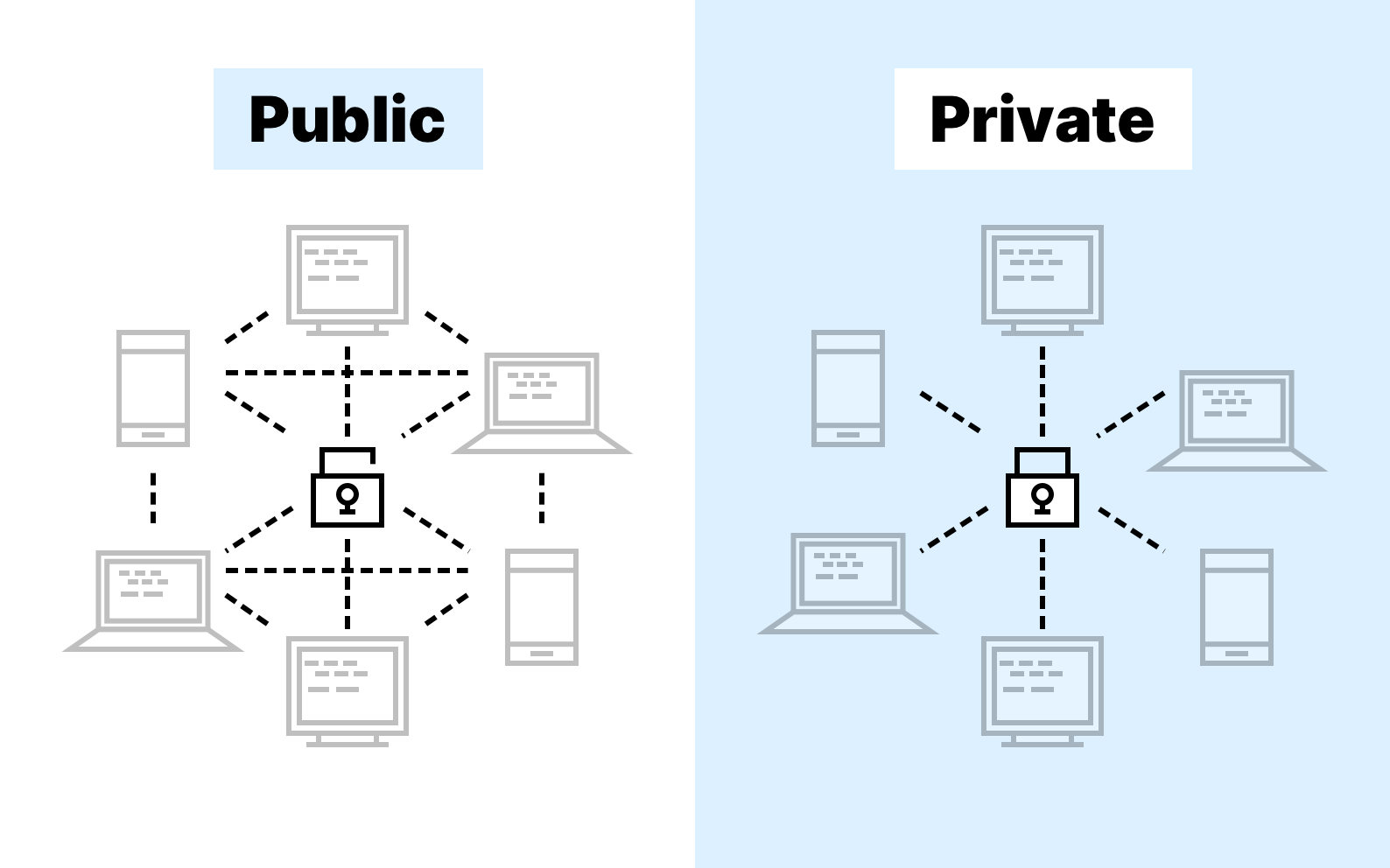
Public and private blockchains use many of the same building blocks, but they are designed for very different trust models.
One allows almost anyone to participate and verify what happens on the network. The other limits access to approved organizations or users.
That distinction affects far more than who can view the ledger. It shapes how the network handles privacy, governance, transaction costs, performance, compliance, and control.
This guide explains the differences between public and private blockchains, where each model works best, and how you can decide whether you need an open network, a permissioned system, a hybrid design, or simply a conventional database.
What is a Public Blockchain?

Public blockchains represent a revolutionary approach to decentralized transaction processing, exemplified by networks like Bitcoin and Ethereum. These blockchain networks are open to anyone with internet access, akin to a global public ledger accessible to all. Imagine a town square where everyone can observe and participate in transactions, with each transaction recorded transparently for all to see.
In the case of Bitcoin, every transaction is broadcast to the network, and validated by miners competing to solve complex mathematical puzzles. Once validated, the transaction is added to a block, forming a chain of blocks that constitute the immutable transaction history. This transparency and decentralization foster trust among participants, as no single entity has control over the network, ensuring the integrity and security of transactions.
Public blockchains offer unparalleled transparency and inclusivity, enabling a wide range of applications beyond cryptocurrency. These networks serve as platforms for decentralized applications (DApps), facilitating peer-to-peer transactions, smart contracts, and even decentralized finance (DeFi) protocols.
For example, Ethereum allows developers to build and deploy smart contracts, self-executing agreements encoded on the blockchain, enabling automated transactions and decentralized applications. The transparency and accessibility of public blockchains democratize access to financial services, empower individuals to control their digital assets, and foster innovation in various industries, from finance to healthcare and beyond. Let us take a deeper dive into the merits and demerits of public blockchain technology.
What are the Advantages of a Public Blockchain?
Here are some reasons why some organizations often opt for public blockchain technology.
1. Decentralization
Public blockchains operate in a decentralized manner, meaning no single entity or authority has control over the network. This decentralization fosters resilience and ensures that no central point of failure exists. Decentralization also promotes censorship resistance, as no single entity can arbitrarily censor transactions or control access to the network. For example, Bitcoin’s decentralized nature ensures that no single government or corporation can manipulate its supply or transaction history.
2. Transparency
Transparency is a core feature of public blockchains, where every transaction is recorded on a public ledger that is accessible to all participants. This transparency enhances trust among users, as they can independently verify transactions and track the flow of funds. For instance, anyone can inspect Bitcoin’s blockchain to verify the validity of transactions and the total supply of coins in circulation. This transparency also promotes accountability, as malicious actors are less likely to engage in fraudulent activities knowing that their actions are visible to the public.
3. Security
Public blockchains leverage cryptographic techniques and consensus mechanisms to ensure the security of transactions and the integrity of the network. For example, Bitcoin uses the Proof of Work (PoW) consensus mechanism, where miners compete to solve complex mathematical puzzles to validate transactions and add them to the blockchain. This process makes it computationally expensive for attackers to tamper with the transaction history, as they would need to control a majority of the network’s computing power. Additionally, the distributed nature of public blockchains makes them resistant to single points of failure and cyber attacks.
4. Accessibility
Public blockchains are open to anyone with an internet connection, allowing for inclusivity and participation from individuals and organizations worldwide. This accessibility democratizes access to financial services and digital assets, particularly in regions with limited banking infrastructure or government censorship. For example, individuals in countries with unstable financial systems or oppressive regimes can use cryptocurrencies like Bitcoin to store and transfer value without relying on traditional banks or government-controlled fiat currencies. Furthermore, public blockchains provide a platform for developers to build decentralized applications (DApps) and smart contracts, fostering innovation and creativity in the blockchain ecosystem.
What are the Disadvantages of a Public Blockchain?
While public blockchain holds much light, it also portends challenges that must be addressed to realize its full potential and foster mainstream adoption. Some of these are:
1. Scalability
Public blockchains face scalability challenges as the number of users and transactions increases. For example, Bitcoin’s blockchain has a limited throughput, processing only a handful of transactions per second. This limitation can lead to congestion and higher transaction fees during periods of high demand. Similarly, Ethereum’s blockchain has encountered scalability issues, particularly during periods of heavy usage such as initial coin offerings (ICOs) or decentralized finance (DeFi) transactions. Scalability solutions such as layer 2 scaling solutions and blockchain sharding are being developed to address these challenges, but implementation and adoption may take time.
2. Governance
Public blockchains often rely on decentralized governance models, where decisions regarding protocol upgrades, consensus mechanisms, and network parameters are made collectively by the community. While decentralization is a key principle of blockchain technology, it can also lead to governance challenges such as debates, disagreements, and forks within the community. For example, disagreements over Bitcoin’s block size limit led to the creation of Bitcoin Cash and subsequent forks. Similarly, Ethereum underwent a contentious hard fork in 2016 following the DAO hack, resulting in the creation of Ethereum Classic. These governance challenges can create uncertainty and volatility within the ecosystem, impacting user confidence and adoption.
3. Energy Consumption
Public blockchains that use Proof of Work (PoW) consensus mechanisms require significant computational resources to validate transactions and secure the network. This process consumes a substantial amount of energy, leading to concerns about environmental sustainability and carbon emissions. For example, Bitcoin mining consumes more energy than some small countries, raising questions about its long-term viability and environmental impact. While some blockchains are exploring alternative consensus mechanisms such as Proof of Stake (PoS) or delegated proof of stake (DPoS) to reduce energy consumption, PoW remains the dominant consensus mechanism for many public blockchains.
4. Privacy Concerns
While public blockchains offer transparency and immutability, they also raise privacy concerns as every transaction is recorded on a public ledger that is visible to all participants. While the pseudonymous nature of blockchain addresses provides a degree of privacy, it is still possible for sophisticated users to trace transactions and identify individuals or organizations involved. For example, blockchain analytics firms can analyze transaction patterns and link addresses to real-world identities, compromising user privacy. Additionally, the transparent nature of public blockchains may deter enterprises and individuals from conducting sensitive transactions or storing confidential information on-chain, limiting their utility in certain use cases such as healthcare or finance.
What are the Use Cases of a Public Blockchain?
Public blockchains have proven to be versatile platforms with a wide range of use cases spanning various industries. Here, we delve into several notable examples that showcase the transformative potential of public blockchain technology: Note that these examples represent just a fraction of the myriad use cases for public blockchain technology.
1. Cryptocurrency
Perhaps the most well-known application of public blockchain technology is cryptocurrency, digital or virtual currencies secured by cryptography and built on blockchain technology. Bitcoin, the first and most famous cryptocurrency, operates on a public blockchain, allowing users to transact peer-to-peer without the need for intermediaries like banks. Ethereum, another prominent public blockchain platform, enables the creation of smart contracts and decentralized applications (DApps), expanding the potential use cases beyond simple currency transactions.
2. Decentralized Finance (DeFi)
Decentralized finance, or DeFi, is an emerging sector leveraging public blockchain technology to recreate traditional financial services in a decentralized manner. DeFi platforms offer a wide range of financial services, including lending, borrowing, trading, and asset management, without the need for intermediaries like banks or brokers. For example, platforms like Uniswap and Compound operate on the Ethereum blockchain, allowing users to trade tokens and earn interest on deposited assets without relying on centralized exchanges or financial institutions.
3. Supply Chain Management
Public blockchains are increasingly being used to improve transparency and traceability in supply chain management. By recording every transaction on an immutable ledger, blockchain enables stakeholders to track the movement of goods and verify the authenticity of products throughout the supply chain. For instance, IBM’s Food Trust platform uses the Hyperledger Fabric blockchain to track food products from farm to table, reducing food fraud, improving food safety, and enhancing trust among consumers.
4. Voting and Governance
Public blockchains offer a transparent and tamper-proof platform for conducting elections and governance processes. By recording votes on a public ledger, blockchain can enhance the integrity and transparency of electoral processes, reducing the risk of fraud or manipulation. For example, the city of Zug in Switzerland conducted a blockchain-based voting trial in 2018, allowing residents to cast their votes on municipal matters using a smartphone app. Similarly, some political parties and organizations have explored blockchain-based voting systems to increase transparency and voter participation in elections.
5. Intellectual Property Management
Public blockchains can be used to manage and protect intellectual property rights, such as patents, copyrights, and trademarks. By timestamping and storing intellectual property records on a public blockchain, creators can establish proof of ownership and enforce their rights more effectively. For example, the Ethereum-based platform known as Verisart enables artists to create blockchain-based certificates of authenticity for their artworks, providing a secure and verifiable way to prove ownership and provenance.
6. Identity Verification
Public blockchains can serve as a secure and decentralized platform for identity verification and authentication. By storing identity credentials on a blockchain, individuals can control and share their personal information securely, reducing the risk of identity theft and fraud. For example, the Sovrin Network is a public blockchain-based platform that enables users to create and manage self-sovereign identities, allowing them to prove their identity without relying on centralized authorities or intermediaries.
What is a Private Blockchain?

In contrast to public blockchains, private blockchains operate within controlled environments, catering to specific organizations or consortia. These networks restrict access to authorized participants, akin to a private conference room where only invited members can engage in discussions. Unlike public blockchains where transactions are validated by a decentralized network of nodes, private blockchains rely on predetermined nodes or validators selected by the governing entity. This controlled validation process ensures greater privacy and control over sensitive data, making private blockchains suitable for enterprises and government entities seeking to streamline operations while maintaining confidentiality.
Private blockchains offer enhanced privacy, scalability, and governance tailored to the needs of enterprise applications. For instance, Hyperledger Fabric provides a framework for building permissioned blockchain networks, enabling businesses to collaborate on supply chain management, identity verification, and financial transactions securely.
These networks prioritize efficiency and compliance, offering features such as access controls, data encryption, and audit trails to meet regulatory requirements and industry standards. While private blockchains may lack the transparency and decentralization of their public counterparts, they offer a pragmatic approach to leveraging blockchain technology for enterprise use cases, empowering organizations to innovate and collaborate in a trusted environment. Let’s take a deeper dive into its advantages and disadvantages.
Advantages of Private Blockchain:
Here we discuss some of the merits of private blockchain technology.
1. Enhanced Privacy
Private blockchains offer greater privacy compared to their public counterparts, as access to the network is restricted to authorized participants. This heightened privacy is particularly beneficial for enterprises handling sensitive information or complying with regulatory requirements. For example, a private blockchain used by a healthcare consortium can ensure that only authorized healthcare providers have access to patient records, protecting patient privacy while facilitating secure data sharing and collaboration.
2. Scalability
Private blockchains can achieve higher transaction throughput and faster confirmation times compared to public blockchains. With fewer nodes to reach consensus, these networks can scale more efficiently to meet business needs. For instance, a private blockchain deployed within a supply chain ecosystem can process a large volume of transactions, such as inventory tracking and product authentication, without experiencing congestion or delays. This scalability enables enterprises to streamline operations and improve efficiency without sacrificing performance.
3. Control
Enterprises deploying private blockchains retain control over the network’s governance, operations, and data management. This control allows for tailored solutions that align with specific business requirements and compliance standards. For example, a financial institution can customize the consensus mechanism and access controls of a private blockchain to ensure regulatory compliance and data integrity. This level of control provides enterprises with greater flexibility and autonomy in managing their blockchain infrastructure and applications.
4. Efficiency
Private blockchains can streamline processes and reduce costs by eliminating intermediaries and automating workflows. Smart contracts, self-executing agreements encoded on the blockchain, enable automated transactions and enforce business logic. For example, a private blockchain used for trade finance can automate the execution of payment terms and shipping documentation, reducing manual errors and delays. These efficiency gains from private blockchains can lead to cost savings and operational improvements for enterprises across various industries.
Disadvantages of Private Blockchain
The following are some limitations of the private blockchain.
1. Centralization
Private blockchains are inherently more centralized than their public counterparts, as access and validation are controlled by a select group of participants. This centralized control may raise concerns regarding trust and security, particularly in industries where decentralization is valued. For example, a consortium of banks operating a private blockchain may face scrutiny over the concentration of power and potential conflicts of interest. Additionally, centralization can undermine the resilience and censorship resistance of the network, as it becomes vulnerable to collusion or coercion by a small group of actors.
2. Interoperability
Interoperability between private blockchains and external systems or other blockchains can pose challenges. Integrating legacy systems or communicating with external parties may require additional effort and resources. For example, a private blockchain used by a supply chain consortium may need to integrate with existing enterprise resource planning (ERP) systems and third-party logistics providers, necessitating complex data mapping and integration processes. This interoperability gap can hinder the seamless exchange of information and transactions between different systems, limiting the scalability and utility of private blockchains.
3. Security Risks
While private blockchains offer enhanced privacy, they may be vulnerable to insider threats or collusion among authorized participants. Ensuring robust security measures and access controls is paramount to mitigate these risks. For example, a private blockchain used for voting or elections may be susceptible to manipulation or fraud by insiders with malicious intent. Additionally, the centralized nature of private blockchains may make them a target for cyber attacks or unauthorized access attempts. Implementing strong authentication, encryption, and auditing mechanisms is essential to safeguard the integrity and confidentiality of data on private blockchains.
4. Cost and Complexity
Deploying and maintaining a private blockchain infrastructure can be costly and complex, requiring significant upfront investment in hardware, software, and personnel. For example, setting up nodes, configuring network parameters, and ensuring compliance with regulatory requirements can involve substantial time and resources. Additionally, ongoing maintenance, upgrades, and support services may incur recurring expenses for enterprises operating private blockchains. This cost and complexity barrier can deter smaller organizations or startups from adopting private blockchain solutions, limiting their accessibility and adoption.
How Public and Private Blockchains Differ in Practice
The distinction becomes clearer when both models are compared across the practical issues organizations face when deploying them.
Access and identity
Public networks commonly identify users by cryptographic addresses. The protocol verifies signatures and balances rather than a person’s legal identity. Applications can still add account verification or compliance checks at their own interfaces.
Private networks usually start with identity. Hyperledger Fabric uses membership service providers and certificate-based identities; Hyperledger Besu can restrict nodes and accounts through permissioning. That makes the network easier to align with contracts and regulatory obligations, but it also creates identity-provider and administrator dependencies.
Privacy and auditability
Public blockchains are built for transparency. Anyone can inspect the ledger, trace transaction history, and verify the network’s state without relying on a central operator. That openness improves auditability, but it also makes public networks unsuitable for storing sensitive personal, financial, or commercial information directly on-chain.
Encryption can conceal the contents of a transaction, but it may not hide metadata such as wallet addresses, timing, transaction size, or patterns of interaction. Because blockchain records remain available for analysis, information that appears private today may become easier to interpret as analytics tools improve.
Private blockchains offer tighter control over who can access specific data. Platforms such as Hyperledger Fabric can restrict information through channels and private data collections, while Corda shares transaction details only with the parties involved and authorized observers. This makes private networks better suited to workflows where participants need a shared, auditable record without exposing every transaction to the entire network.
Security and trust
Neither model wins security by default. Public chains can make historical manipulation economically or computationally expensive and can avoid a central administrator. Their applications still face smart-contract bugs, bridge failures, key theft, validator concentration, and governance attacks.
Private chains reduce anonymous access and can use enterprise identity, monitoring, and recovery procedures. They also concentrate authority among fewer known parties. Insider abuse, compromised administrators, colluding validators, weak key management, or a poorly designed governance agreement can undermine the network. IBM’s blockchain security guidance therefore recommends examining governance, identity, data access, consensus, and participant incentives rather than treating the ledger as secure in isolation.
Performance, fees, and finality
Private networks often process transactions with lower and more predictable latency because they coordinate a known validator set and do not sell scarce block space through a public fee market. That is a design tendency, not a law. A poorly configured private network can stall, while a well-designed public chain or scaling network can provide fast confirmation.
The more useful comparison is workload-specific: sustained throughput, finality time, failure recovery, validator geography, data growth, integration cost, and the consequences of a network partition. Vendor transactions-per-second figures are not substitutes for testing the application’s actual workflow.
Governance and reversibility
Public-chain history is difficult to change because many independent participants must accept a new state or protocol rule. “Immutable” still does not mean physically impossible to alter: public networks can fork, applications can upgrade, and governance can decide how to respond to exceptional events.
Private networks can define clearer correction and recovery procedures. That is useful when a court order, operational error, or revoked credential requires intervention. It also means participants must trust the governance body not to use those powers arbitrarily.
Which blockchain should an enterprise choose?
A blockchain earns its complexity when several parties need a shared record and participants require a common method for validating changes. If one organization controls all writes and everyone already trusts it, a conventional database is usually the better starting point.
Five Questions to Answer Before Choosing
- Do several independent organizations need to write to the same record?
- Must people outside that group be able to verify the record?
- Can transaction details, counterparties, and balances be public?
- Do validators need verified legal identities and contractual obligations?
- Who may change the rules, correct errors, revoke access, or respond to a court order?
Choose a Public Blockchain When
- Open access and independent public verification are core requirements.
- The application needs public liquidity, tokens, shared settlement, or composability with existing protocols.
- No consortium should control admission or the canonical record.
- The organization can keep sensitive data off-chain or use a defensible privacy design.
Choose a Private Blockchain When
- Participants are known organizations with contractual relationships.
- Transaction data must be restricted by role, organization, or legal entitlement.
- The group needs defined governance, membership, service levels, and recovery procedures.
- The business process benefits from a shared ledger but cannot rely on a fully public state.
Consider a Hybrid Design When
The workflow needs confidential execution and public proof, settlement, or asset mobility. A hybrid architecture might keep business data in a permissioned system, publish hashes or attestations to a public chain, and settle selected assets on a public network. The design must state exactly what the public proof establishes; anchoring a hash does not prove that the underlying private data was complete or correct.
Can Enterprises Use Public Blockchains?
Yes. An enterprise can use a public blockchain without publishing every business record or allowing every user to call every application function. Common patterns include permissioned application interfaces, off-chain storage, encrypted payloads, zero-knowledge proofs, Layer 2 networks, and public settlement for assets whose ownership must be widely verifiable.
The hard part is deciding what the public chain should prove. Public networks are strongest when they provide neutral settlement, a publicly auditable asset, or coordination across parties that do not share a private governance framework. They are a poor place for raw personal data, confidential contracts, or records that must be deleted.
Where Vezgo Fits
Vezgo is not a public- or private-blockchain platform. It is a read-only crypto data API that lets an application retrieve and normalize a user’s balances, positions, and transaction history across connected exchanges, wallets, and blockchains. The application’s network architecture and its data-integration layer are separate decisions.
For example, a portfolio, tax, accounting, or wealth application may need data from public blockchain addresses, self-custody wallets, and centralized exchange accounts at the same time. Vezgo provides a common account and transaction model so the product team does not have to maintain a different connector for every source. Developers can review the supported integrations and the Vezgo API documentation before choosing the connectors and sync behavior their product requires.
That role complements node providers, indexers, and enterprise blockchain platforms; it does not replace them. A node or private ledger supplies network state. Vezgo supplies normalized, user-authorized account data across many sources.
Let’s Talk About Vezgo

We introduce you to Vezgo, the cutting-edge crypto API revolutionizing how developers access and aggregate users’ cryptocurrency data. With Vezgo’s unified API, developers can seamlessly retrieve and consolidate users’ cryptocurrency balances, tokens, and transaction history across a myriad of exchanges, wallets, and blockchains. Gone are the days of grappling with disparate data sources and complex integrations. Vezgo simplifies the process, offering a single point of access for all crypto-related data needs.
Vezgo’s API boasts support for both centralized and decentralized crypto data, ensuring developers have access to a comprehensive dataset regardless of the source. By delivering consistent data formatting and timely updates, Vezgo empowers developers to build robust applications with confidence, knowing they have access to accurate and up-to-date information. Whether retrieving position and balance data in native or fiat values, Vezgo’s user-friendly API makes it effortless to access crypto account information across multiple exchanges, blockchains, and wallets.
In addition to its prowess in accessing and aggregating cryptocurrency data, Vezgo offers a comprehensive solution for developers seeking to integrate non-fungible token (NFT) data into their products. Vezgo’s NFT API allows developers to effortlessly retrieve NFT data on more than six blockchain chains, including Ethereum, Binance Smart Chain, Polygon, Avalanche, Fantom, and Cronos. This broad support streamlines the process of obtaining NFT information, automating the gathering of data from multiple blockchain protocols and organizing it for easy access and analysis. Whether building NFT marketplaces, gaming platforms, or digital collectibles applications, developers can leverage Vezgo’s NFT API to enrich their products with valuable NFT data seamlessly.
FAQs
These are answers to some of the most commonly asked questions about public and private blockchains.



Leave a Reply