


Digital banking is the online and mobile delivery of traditional fiat banking services. Crypto banking is the management of cryptocurrency assets through institutions that custody, trade, lend, or settle in digital assets. Both run on technology. Only one runs on a blockchain.
The distinction matters more in 2026 than it did three years ago. The OCC granted conditional national trust bank charters to Circle, Paxos, Ripple, and others in late 2025 and early 2026, per Brookings. MiCA gave European banks a single passportable framework for digital assets. BBVA, DZ Bank, KBC, and Société Générale have all gone live with regulated crypto trading, per CoinDesk. The borders between these two banking models are dissolving, but the core differences still shape every product built on either side.
This guide breaks down what each model is, how they differ in technology and regulation, where they meet, and what developers building at the intersection need to understand.
What is Digital Banking?

Digital banking is the electronic delivery of traditional banking services through web platforms and mobile apps, using fiat currencies on existing payment rails. A digital bank lets customers open accounts, make payments, transfer funds, and manage credit without visiting a branch.
Account opening that used to take days now takes minutes. Challenger banks like Revolut, Wise, Monzo, N26, and Chime built their entire offerings around that convenience. They sit on top of the same underlying payment networks (ACH, SWIFT, SEPA, card schemes) as traditional banks. They just package the experience differently.
The technology stack is conventional. Centralized databases hold balances. Established compliance teams run KYC and AML. Deposit insurance schemes (FDIC in the US, FSCS in the UK, similar frameworks elsewhere) protect customer funds up to defined limits. Per Suisse Bank’s 2026 comparison, Revolut, Mercury, and a few other fintechs now also offer direct crypto trading inside the same app, but the underlying account is still a fiat banking account.
What is Crypto Banking?

Crypto banking is the use of cryptocurrencies and stablecoins for storing value, making payments, earning yield, and settling transactions through institutions purpose-built for digital assets. Some crypto banks operate fully on-chain. Others bridge fiat and crypto under regulated charters.
The model splits into three categories per BitGo’s 2026 analysis:
- Traditional banks offering crypto services. Banks that have added custody, trading, or settlement of digital assets to existing offerings. BBVA, DZ Bank, and Société Générale’s Forge subsidiary fit here.
- Crypto-native firms with bank charters. Companies like Circle, Paxos, and Ripple that received OCC conditional approvals for national trust bank charters in late 2025 and early 2026.
- Hybrid models. Firms like BitGo that received OCC approval to convert into a federally chartered national trust bank, providing institutional custody under federal regulation.
Crypto banks let users earn interest on stablecoin or BTC deposits, borrow against digital asset collateral, settle international payments in seconds, and move funds across borders without correspondent banking intermediaries. The infrastructure depends on blockchain consensus mechanisms, smart contracts, and on-chain settlement rails.
Why Are Regulated Crypto Banks Growing in 2026?
Regulators across major jurisdictions have shifted from blocking crypto banking to defining the rules under which it can operate. That shift is what unlocked the wave of new charters and bank crypto products in 2026.
The US passed the GENIUS Act in July 2025, establishing a federal framework for payment stablecoins. Per Brookings, the OCC granted conditional national trust bank charters to Circle, Paxos, Ripple, and at least seven other firms between December 2025 and early 2026. The largest USD-backed stablecoins now circulate at roughly $190 billion (USDT) and $80 billion (USDC).
The EU’s MiCA framework took full effect in late 2024 and finished its grandfathering window on July 1, 2026. Per CoinDesk, MiCA “collapsed [the] complexity into a single, passportable framework.” Banks in any member state can now offer digital asset services under one regulatory regime. That is why BBVA in Spain, DZ Bank in Germany, KBC in Belgium, and Société Générale in France have all moved within twelve months of each other.
The result is institutional. TRM Labs’ Q1 2026 Global Crypto Adoption Index shows global retail crypto activity at $979 billion in Q1 2026, with the United States leading at $212 billion. The infrastructure handling that volume is increasingly bank-grade.
Crypto Banking vs. Digital Banking: Side-by-Side
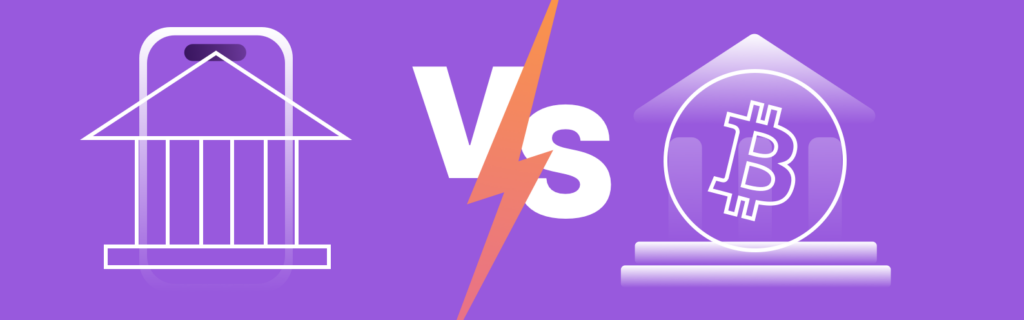
The core differences sit across five dimensions: currency, technology, security, regulation, and use cases. The table below summarizes them.
| Dimension | Digital Banking | Crypto Banking |
|---|---|---|
| Currency | Fiat (USD, EUR, GBP) | Cryptocurrencies and stablecoins |
| Technology | Centralized databases, traditional payment rails | Blockchain, smart contracts, on-chain settlement |
| Security | Established protocols, regulatory frameworks | Cryptographic algorithms, decentralized validation |
| Regulation | Mature, jurisdiction-specific (FDIC, FSCS, etc.) | Evolving (GENIUS Act, MiCA, OCC charters) |
| Settlement speed | Seconds to days, depending on rail | Seconds to minutes, 24/7 |
| Insurance | Deposit insurance up to defined limits | Custody insurance, varies by provider |
| Best fit | Everyday banking, payroll, fiat payments | Cross-border value transfer, yield, programmable money |
Each row hides important nuance. The next four sections walk through the differences that matter most for users and developers.
1. Currencies Involved
Digital banks operate in fiat. Every transaction settles in a currency issued by a central bank, even when the user interface looks crypto-native. Crypto banks operate in digital assets. Bitcoin, Ether, USDT, USDC, and other tokens move through the system as the underlying medium of exchange.
The distinction is shrinking at the edges. Stablecoins blur the line because they are crypto-native technically but pegged to fiat economically. Per Brookings, banks broadly express interest in issuing tokenized deposits and using third-party stablecoins, even when they are not interested in issuing their own.
2. Underlying Technologies
Digital banking runs on conventional financial infrastructure. ACH for US domestic transfers. SEPA for European transfers. SWIFT for international wire transfers. Card networks like Visa and Mastercard. These rails have decades of operational history but settle in batches and take days for cross-border transactions.
Crypto banking runs on blockchains. Settlement happens at the speed of the underlying network, often in seconds or minutes regardless of where the counterparty sits. Layer 2 scaling solutions like Arbitrum and Base have brought transaction costs down to fractions of a cent, making crypto banking viable for everyday transactions, not just large transfers.
3. Security and Privacy Approaches
Digital banks handle security centrally. The bank holds the keys, runs the fraud monitoring, and absorbs liability for unauthorized transactions within defined limits. Customers trust the institution and the regulatory framework that backs it.
Crypto banks handle security cryptographically. Self-custody products give users full control of their private keys. Custodial crypto banks hold assets in cold storage, multi-signature wallets, and insured cold-storage frameworks. Both models record transactions on a public ledger, which creates transparency that fiat banking cannot match.
4. Regulatory and Compliance Frameworks
Digital banks operate under mature, jurisdiction-specific frameworks. FDIC insurance in the US covers deposits up to $250,000. FSCS in the UK covers up to £85,000. The Gibraltar Deposit Guarantee Scheme covers €100,000, per Bitget’s review of Xapo Bank. These limits are well-understood by users and businesses.
Crypto banks operate under newer frameworks. The GENIUS Act in the US, MiCA in the EU, and OCC trust bank charters all establish defined regulatory perimeters, but the specifics are still being interpreted. Tokenized deposits enjoy traditional bank deposit insurance up to standard limits per Brookings. Stablecoin holdings outside a bank do not. That gap is one reason corporates often prefer tokenized deposits for cross-border payments.
Where Do Crypto Banking and Digital Banking Meet?

The convergence point in 2026 is the regulated digital asset bank, where one institution holds both fiat deposits and crypto assets under coordinated regulatory oversight. The OCC charters granted to Circle, Paxos, Ripple, and others put crypto-native firms inside the same supervisory framework as traditional banks. European banks moving onto MiCA have done the same from the opposite direction.
Three concrete convergence points are visible:
- Crypto-collateralized lending. Banks accepting BTC, ETH, or stablecoin collateral for loans, including products like crypto-backed mortgages and structured credit lines.
- Tokenized deposits. Banks issuing digital representations of customer deposits on a distributed ledger, settling instantly while keeping the underlying asset inside the regulated banking perimeter.
- Stablecoin on/off ramps inside bank apps. Banks letting customers move between fiat and stablecoins without leaving the bank’s interface, with KYC and AML handled at the account level.
How Do CBDCs Fit Into the Picture?

Central bank digital currencies (CBDCs) are digital fiat issued directly by a central bank, combining the technical efficiency of crypto banking with the institutional trust of digital banking. They are not cryptocurrencies in the decentralized sense. They are digital dollars, euros, or yuan issued and controlled by the issuing authority.
The Federal Reserve published its foundational CBDC analysis in January 2022, and central banks across the world have continued to research the model. China’s e-CNY is the largest pilot in production. The European Central Bank moved into the preparation phase for a digital euro in late 2025. The US has not committed to a retail CBDC, with the Trump administration’s January 2025 executive order explicitly ruling one out.
CBDCs sit at the intersection because they use ledger technology like crypto banking but operate inside the regulatory perimeter like digital banking. They potentially deliver programmable money, instant settlement, and financial inclusion through digital wallets without exposure to private-issuer credit risk.
What Are the Concerns About Crypto Banking?
Crypto banking carries five practical concerns: regulatory uncertainty, custody risk, contagion to traditional banks, money laundering exposure, and consumer protection gaps. Each one is being actively addressed, but none has been fully resolved.
Regulatory uncertainty has narrowed in 2026 but persists at the edges. Per the Congressional Research Service, crypto exposure played a role in the failures of Silvergate and Signature Banks in 2023. That history shaped the cautious posture of regulators through 2024 before the policy shifts of 2025 and 2026 began opening the door again.
Custody risk is structural. Even regulated crypto banks must protect private keys, prevent insider theft, and recover from operational mistakes. The 2025 hack data compiled by Chainalysis showed roughly $3.41 billion stolen across the year, with personal wallet compromises driving the largest share. That risk profile is what keeps insurance markets and audit standards evolving.
Money laundering exposure remains a focus for the Financial Action Task Force, FinCEN, and equivalent regulators. The OECD Crypto-Asset Reporting Framework (CARF) and the EU’s DAC8 directive both came into force to address it. Crypto banks now run KYC and KYT enrichment, crypto wallet and address screening, and source-of-funds analysis workflows that mirror traditional bank compliance.
Why the Future of Money Needs Both
The two models serve different needs, and the most useful financial system is the one that lets users move between them without friction. Digital banking serves everyday transactions, payroll, mortgages, and the broad fiat economy. Crypto banking serves cross-border value transfer, programmable settlement, yield on digital assets, and access for people excluded from traditional banking.
Per SQ Magazine’s 2026 demographics analysis, crypto wallet usage now reaches roughly 1 billion people globally who would otherwise lack access to financial tools. That access is not a substitute for digital banking. It is an extension of it.
The strongest products in 2026 do not pick one model. They integrate both. A user holds a fiat checking account for daily expenses, a stablecoin balance for international transfers, a tokenized deposit for treasury management, and a self-custody wallet for long-term BTC holdings. The interface should make those switches invisible.
How Does Vezgo Help Build Products at the Convergence?

Vezgo provides a single API that aggregates balance, position, and transaction data across more than 300 exchanges, wallets, blockchains, and DeFi protocols. For developers building at the intersection of crypto and digital banking, this removes the work of integrating each venue separately.
A neobank adding crypto features uses Vezgo to surface user holdings across CEXs and self-custody wallets in one dashboard. A digital wealth platform integrates Vezgo to give users a unified view across fiat brokerages and crypto venues. A treasury management product feeds Vezgo data into reporting workflows that previously required manual reconciliation.
The same data foundation supports related workflows like crypto wallet APIs for developers and businesses, portfolio and exposure risk monitoring, and the broader Vezgo API use cases that span lending, tax, accounting, and compliance products.
Security is built in. Financial information links only to anonymous UUIDs. SOC 2 Type 2 compliance and AES-256 encryption back the data path. The API uses read-only access patterns, so connecting an account does not expose private keys. Pricing starts with a Free-to-Try plan and scales through usage-based tiers, all on the Vezgo pricing page.
For teams building digital bank products that touch crypto, Vezgo handles the data layer so the engineering team can focus on the user experience.



Leave a Reply